February 2026 Substance Use Confidentiality Update for Therapists
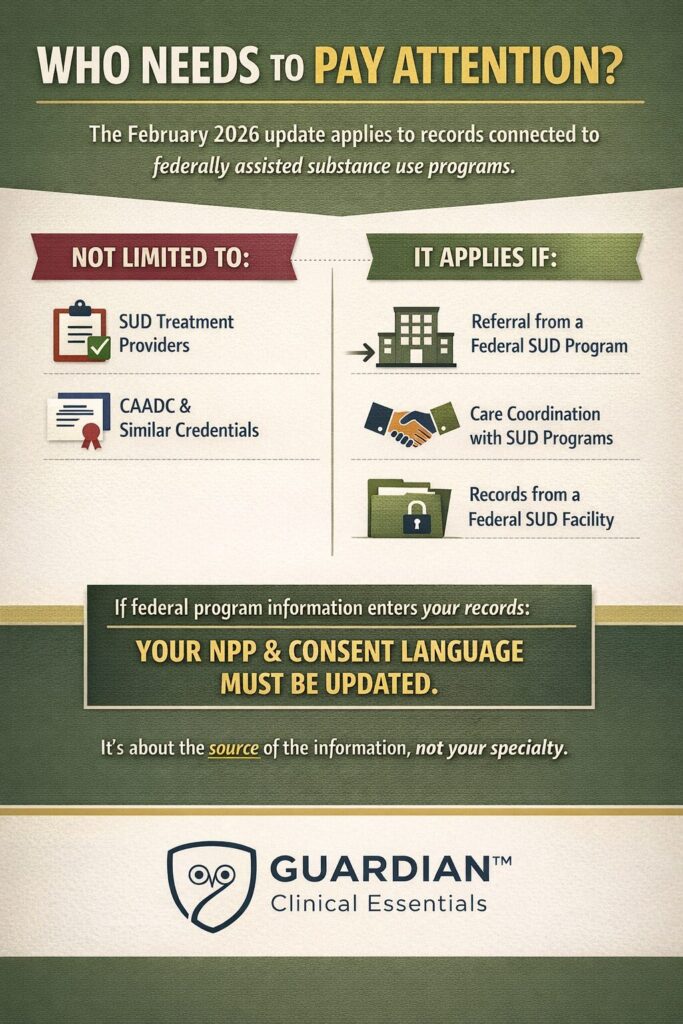
This update applies based on where substance use information originates, not on therapist credentials or specialty.
There is a February 2026 update to the federal confidentiality rules that govern certain substance use disorder records.
This update is often described as a “HIPAA change,” but that framing is incomplete and, in many cases, misleading. What matters is not whether you treat substance use directly, but whether substance use information from federally assisted programs enters your records.
This post explains what mental health therapists actually need to know, when the update applies, and when it does not.
What this update is about
This update relates to the federal confidentiality rules that apply to records connected to federally assisted substance use disorder programs, commonly referred to as 42 CFR Part 2.
These protections arise under federal law governing substance use disorder records (42 CFR Part 2), which operates alongside HIPAA.
These rules exist alongside HIPAA and apply based on the source of the information, not a provider’s credentials, specialty, or scope of practice.
Therapists often search for this update when trying to determine whether Part 2 applies to their practice.
These rules are administered and interpreted through federal guidance issued by SAMHSA.
What this update does NOT hinge on
Treating substance use as a primary focus
Holding a CAADC or similar credential
Identifying as a substance use treatment program
When this update DOES apply
Substance use information originating from a federally assisted program
Referrals from federally assisted substance use programs
Care coordination with those programs
Records or documentation entering your clinical file
Does this February 2026 update apply to my therapy practice?
Does this apply if I do not treat substance use disorders?
Yes, it can. This update applies based on whether substance use information from a federally assisted program enters your records, not on whether you primarily treat substance use.
Does this apply only to providers with CAADC or similar credentials?
No. Credentials do not trigger these requirements. The trigger is whether records originate from a federally assisted substance use disorder program.
When does this update actually apply to therapists?
It applies when substance use information from a federally assisted program is received through referrals, care coordination, or records that enter your clinical file.
If this does not apply to my practice, do I need to do anything?
In most cases, no. If your practice does not receive records or referrals from federally assisted substance use programs, this update is unlikely to require changes.
What changed
One written consent may authorize future uses and disclosures for treatment, payment, and health care operations
Substance use disorder information may be integrated into the clinical record consistent with federal confidentiality requirements
Redisclosure is permitted under HIPAA once information is lawfully shared
HIPAA breach notification rules apply to this information
What did not change
Consent is still required
Clients retain privacy rights
The minimum necessary standard still applies
Documentation should remain clinically relevant
Professional and ethical standards did not change
Written consent must still meet federal authorization requirements.
This update simplifies process.
It does not reduce responsibility.

What Mental Health Practices Should Know
If this update applies to your practice, review the following areas:
Notice of Privacy Practices language
Consent language related to substance use disclosures
Documentation standards for substance use information
Breach response policies
How staff or contractors handle information originating from federally assisted programs
Many EHR-provided Notices of Privacy Practices are generalized and not customized to state or federal nuances. This is a common compliance gap.
Want Updates Like This?
If you want to stay informed on HIPAA and compliance updates for mental health providers, you can join my email list below.
What most therapy practices should take away
For many therapy practices, this update will have no practical impact.
If your practice does not receive records or referrals from federally assisted substance use programs, you likely do not need to make changes.
If it does, small, targeted updates now are far easier than correcting documentation issues later.
For reference, I’ve created a short, plain-language PDF summary that explains when this update applies and what documents may need review.
This summary is educational and not legal advice. State laws may impose additional requirements.
This update applies based on where substance use information originates, not on therapist credentials or specialty.
Common points of confusion
This update is frequently misunderstood as:
Applying only to substance use specialists
Being triggered by credentials rather than record source
Removing consent requirements
Allowing broader sharing of substance use information
None of those interpretations are accurate.
Most risk around this update comes from misunderstanding it, not ignoring it.
Final note
The February 2026 update reduces administrative friction in specific situations.
It does not change professional responsibility.
Clarity matters more than urgency.
What We’re Watching
As the February update continues to be interpreted across the field, some professionals are exploring how sensitive counseling content may be handled as Part 2 aligns more closely with HIPAA. The regulation does not create a new documentation category at this time, and no workflow changes are required. Guidance may continue to evolve, and practical implementation recommendations will follow if expectations become clearer.
About the Author
Samantha Schalk, LMSW-C, LMSW-M, CAADC, CIMHP, BCP3
Samantha is a licensed mental health professional, private and group practice owner, and the founder of Guardian Clinical Essentials™, where she helps therapists and group practices implement practical, audit-ready HIPAA and state-specific compliance systems.
Drawing from direct experience in clinical practice and compliance consulting, Samantha specializes in translating complex federal and state regulations into clear, usable policies, tools, and workflows designed specifically for mental health providers.