
Your Biggest Compliance Risk Is the One You Don’t See Coming

Most therapists assume they are compliant until an audit proves otherwise.
HIPAA compliance is not based on what you believe you are doing correctly. It is based on what you can produce, document, and defend when asked.
Without written HIPAA policies, a completed Security Risk Analysis, and your state’s requirements clearly documented, you are already out of compliance and would likely fail an audit.
The Security Risk Analysis is the foundation of the HIPAA Security Rule and one of the most common enforcement findings cited by the Office for Civil Rights (OCR).
Does using an EHR make me HIPAA compliant?
No.
An EHR is a tool, not proof of compliance.
HIPAA requires documented policies, a completed Security Risk Analysis, and ongoing risk management regardless of what software you use. Many fined providers had EHR systems but no documented risk analysis.
HIPAA Compliance Monitoring System
+ Security Risk Analysis
A structured compliance solution designed for mental health practices that need to complete, document, and maintain their HIPAA Security Risk Analysis.
Whether you are a solo provider or operating a group practice, HIPAA requires more than good intentions, an EHR, or a few signed agreements. It requires documentation, risk evaluation, and an ongoing process for identifying and addressing compliance gaps.
This page will help you choose the version that fits your practice structure and level of complexity.
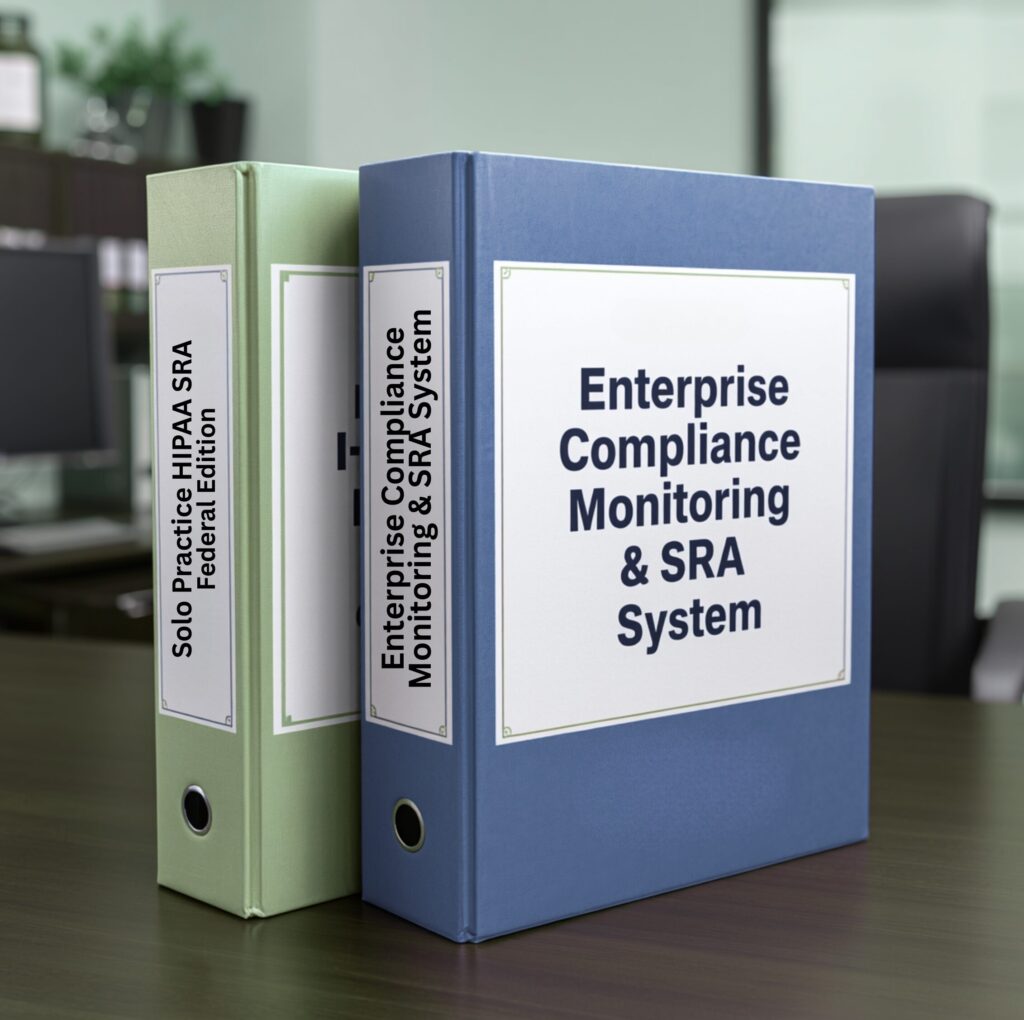
HIPAA Security Risk Analysis for Mental Health Practices. Image is intended to represent digital product.
The Compliance Gap You Did Not Know You Had
Federal enforcement repeatedly finds the same issues:
Your EHR does not make you HIPAA compliant
HIPAA requires written policies and a documented Security Risk Analysis
Practices often assume they are covered until they are asked to produce proof
As practices grow, compliance gaps often expand across staff, systems, workflows, and state-specific requirements
Without these in writing, you risk:
Having no proof of compliance during an audit
Missing critical requirements you were never taught
Fines, ethics complaints, or board action against your license
And this is not rare. Licensing boards, insurance panels, and federal auditors request these documents every single year.
When you cannot produce them, you are already out of compliance, even if no breach has occurred.
And here is the part most therapists do not realize:
Providers are getting fined right now for failing to complete their Security Risk Assessments.
If you want a deeper breakdown of what actually counts as a Security Risk Analysis and where most practices fall short, you can read the full explanation here:
What Actually Counts as a HIPAA Risk Assessment (and What Doesn’t)
This Is Not Theoretical -
Providers Are Being Fined for Skipping SRAs
These are real enforcement actions from the U.S. Department of Health and Human Services Office for Civil Rights (OCR). Every single one involved failing to complete a proper Security Risk Analysis (SRA) and the penalties were severe.
Deer Oaks Behavioral Health
📄 The Trigger: Ransomware attack in August 2023 exposed PHI for more than 171,000 individuals.
⚠️ The Finding: OCR found Deer Oaks had not conducted an accurate and thorough risk analysis as required by HIPAA.
💸 The Outcome: $225,000 settlement and a two-year corrective action plan requiring a compliant SRA and ongoing monitoring. (HHS OCR, July 7, 2025)
Anchorage Community Mental Health Services
📄 The Trigger: Malware infection exposed ePHI for 2,743 individuals.
⚠️ The Finding: OCR determined the provider had not conducted a thorough risk assessment and was running outdated, unpatched software.
💸 The Outcome: $150,000 settlement plus a corrective action plan mandating a complete SRA and security updates. (HHS OCR, December 2014)
Metro Community Provider Network (Denver)
📄 The Trigger: Phishing attack compromised ePHI for 3,200 individuals.
⚠️ The Finding: OCR concluded the provider failed to perform a comprehensive risk analysis and lacked a formal risk management process.
💸 The Outcome: $400,000 settlement and a multi-year corrective action plan, including a complete SRA. (HHS OCR, April 12, 2017)
Avoid These Penalties - Get Your Security Risk Analysis Completed
Is a Security Risk Assessment required by law
or just recommended?
Required.
HIPAA mandates an accurate and thorough risk analysis for any practice handling electronic protected health information. This is a legal requirement under the HIPAA Security Rule, not a best practice.
Required under 45 CFR §164.308(a)(1)(ii)(A)
What You’ll Get
Instead of spending months piecing together policies, you will receive a complete, editable system that:
Reveals Hidden Compliance Gaps
Shows you exactly where your practice is out of alignment with HIPAA regulations allowing you to address concerns and improve security
Meets the Federal SRA Requirement
Fulfills HIPAA’s mandatory Security Risk Analysis requirement and provides a structured framework to document and maintain compliance over time

Creates an Audit-Ready Paper Trail
Provides organized documentation you can produce during an audit, licensing review, or insurance panel request
Keeps Your Compliance Current
Includes built-in structure to track tasks, assign responsibilities, and maintain compliance over time
Provides State-Tailored Policies
Includes editable policies and forms aligned with your license type, services, and location
Yes - The Security Risk Assessment Is Mandatory
HIPAA requires:
“An accurate and thorough assessment of the potential risks and vulnerabilities to the confidentiality, integrity, and availability of electronic protected health information.”
– HIPAA 45 CFR §164.308(a)(1)(ii)(A)
This system fulfills the federal Security Risk Analysis requirement and provides the structure needed to document and maintain compliance. State-specific requirements are addressed within the appropriate system for your practice type.
Who This System Is For
Solo or group mental health practices
Clinical supervisors and compliance officers
Practice owners preparing for audits, Medicaid enrollment, or board reviews
Providers offering telehealth or services across state lines
Designed for Ongoing Use

Use this system:
Annually – to meet HIPAA’s compliance review requirement
When you add services, platforms, or staff – so your policies match your operations
After a suspected breach or complaint – to document corrective action. For a structured process on how to assess, respond to, and document potential breaches, see the HIPAA Breach Response & Documentation System.
Before a board, Medicaid, or insurance audit – to prove compliance
Choose the Compliance System
That Fits Your Practice
You do not need to figure this out on your own. Choose the version that matches your practice structure and level of complexity.
Solo Practice System
Solo Practice HIPAA Security Risk Analysis – Federal Edition
A streamlined, audit-ready system designed for independent therapists who need to meet HIPAA requirements and document compliance without unnecessary complexity.
Includes:
• Complete Security Risk Analysis framework
• Core compliance tracking tools
• Editable logs and documentation
• Audit-ready structure aligned with HIPAA
requirements
Best for:
• Solo private practice therapists
• No staff or minimal contractors
• Lower operational complexity
Value: $3,250
Regular Price: $1,997
Limited-Time Price: $997
“I didn’t realize how much I didn’t know.”
Enterprise / Group Practice System
Enterprise HIPAA Compliance Monitoring & Security Risk Analysis System
A full compliance operating system designed for group practices, multi-provider settings, and practices with increased operational risk, staff oversight, and regulatory exposure.
Includes:
• Enterprise-level Security Risk Analysis system
• Full compliance monitoring structure
(Sections 1–10)
• Workforce oversight, access tracking, and
sanctions logs
• Vendor risk management and documentation
• Audit-defense documentation system
Best for:
• Group practices
• Multi-provider or multi-location settings
• Practices with staff, billers, or contractors
• Practices preparing for audits, Medicaid, or
scaling
Value: $9,800
Regular Price: $2,497
Limited-Time Price: $1,497
“This likely saved me thousands of dollars in potential fines.”
Operating in More Than One State?
Multi-state compliance requires integrated documentation to prevent conflicting rules, compliance gaps, and audit exposure.
Licensing & Terms
One license = one practice location
Editable for internal use only
Includes watermark + locked headers/footers
Resale prohibited
Future legal updates not included but may be offered separately
Format & Delivery
📥 Delivered within 3–5 business days
🖊️ Customized with your business name + watermark
🔐 Internal-use license (one business)
🖊️ Fully editable + customizable
📅 Reusable until regulations change
Security Risk Analysis Questions
Therapists Ask Most
Do therapists actually have to complete a Security Risk Analysis?
Yes.
HIPAA requires every covered entity to conduct an accurate and thorough assessment of risks to electronic protected health information. This is a federal requirement, not a best practice.
How often does a Security Risk Analysis need to be completed?
Best practice is annually or whenever practice changes occur.
There is no fixed annual requirement in HIPAA law. A Security Risk Analysis must be completed initially and updated whenever your practice changes or new risks emerge. Most compliance experts recommend reviewing it at least annually as a best practice.
What happens if I have never completed an SRA?
You are already out of compliance.
Failure to complete a Security Risk Assessment is one of the most common findings in federal enforcement actions. If a breach, complaint, or audit occurs, you may face penalties and be required to complete one under a corrective action plan.
Is a Security Risk Analysis only required for large practices or hospitals?
No.
HIPAA applies to solo providers and small practices as well.
Any practice that creates, receives, maintains, or transmits electronic protected health information must complete and maintain a Security Risk Assessment, regardless of size.
What exactly does a Security Risk Analysis evaluate?
It evaluates how your practice protects client information.
This includes devices, email, telehealth platforms, EHR systems, staff access, storage methods, and breach readiness. The goal is to identify vulnerabilities and document how you are addressing them.
Is this the same as a HIPAA checklist or training?
No.
A checklist or training does not replace a risk assessment.
HIPAA requires written analysis of risks and documented risk management steps. Education alone does not satisfy the Security Rule requirement.
Will completing an SRA prevent an audit?
No.
But not having one guarantees problems if you are audited.
A completed and maintained Security Risk Assessment demonstrates active compliance. Without it, you cannot show regulators or licensing boards that required safeguards are in place.
Does this include state laws or only federal HIPAA?
It depends on the system you choose.
The Solo Practice SRA System is designed to meet federal HIPAA requirements.
The Enterprise Compliance Monitoring & SRA System includes both federal HIPAA and state-specific mental health compliance requirements.
What kinds of penalties happen when SRAs are missing?
Financial settlements and corrective action plans are common.
Federal enforcement actions frequently cite failure to complete a Security Risk Assessment. Penalties may include fines, required monitoring, and multi-year compliance oversight.
Is an SRA a one-time document or something I maintain?
It must be maintained and updated.
HIPAA expects practices to review and update their risk analysis regularly. Each update should reflect current technology, staffing, and services.
Who should be responsible for completing the SRA in a practice?
Practice leadership is responsible.
Owners, compliance officers, or designated privacy and security leads typically oversee the process. Even in solo practices, responsibility cannot be delegated away.
What should happen after the Security Risk Analysis is completed?
Risk management and ongoing monitoring must follow.
HIPAA expects practices to address identified risks, update policies, and document corrective actions. A structured monitoring system helps ensure compliance stays current as your practice evolves.
What is the difference between a Security Risk Assessment and a Security Risk Analysis?
They are often used interchangeably. Under HIPAA, the requirement is an “accurate and thorough risk analysis” identifying vulnerabilities to ePHI, followed by risk management actions.
What law requires a Security Risk Analysis?
HIPAA Security Rule – 45 CFR §164.308(a)(1)(ii)(A)