Group Practice Compliance
Isn’t Just Bigger.
It’s Riskier.
Most group practices are operating with shared access, inconsistent training, and gaps in documentation they don’t even realize exist. This bundle was built to close those gaps before they become a problem.
Everything you need to structure, document, and defend your HIPAA compliance as a group practice.
Estimated Delivery Timeline:
Most Guardian Group Practice Compliance Suite engagements are completed within 15–20 business days. Timelines may vary based on current client volume, practice size, state-specific requirements, customization needs, and organizational complexity.
Built Specifically for Group Practices Managing PHI Across Multiple People
This is not a scaled-up version of a solo practice system.
Group practices introduce a completely different level of risk.
More people accessing PHI. More devices. More variability in documentation, training, and oversight.
This bundle is designed for:
✔ Group practice owners managing multiple clinicians
✔ Practices using W2 staff, 1099 contractors, interns, or assistants
✔ Teams sharing EHRs, Google Workspace, or other systems
✔ Practices preparing for growth, audits, or increased oversight
If more than one person can access your client data, your compliance requirements change.

This Is Not a Checklist. This Is a Compliance System.
HIPAA does not ask if you are “trying to be careful.”
It asks if you can show:
• What risks exist in your practice
• What you’ve done to address them
• How you are maintaining compliance over time
If it isn’t documented, it doesn’t exist.
This bundle gives you the structure, documentation, and tracking system to actually prove compliance.
What’s Included in
Guardian Group Practice Compliance Suite™
10 Compliance Systems & Documentation Packages
Designed for Group Practices
Everything below is structured, documented, and ready to implement.
01.
Foundation Compliance System
This is your foundation. Policies, state law, and required risk analysis.
02.
Contracts, Vendors & Risk Protection
- State-Specific Business Associate Agreement (BAA) Toolkit
- 1099 Contractor Device Security Packet
- Emergency Contact & Delegation Form
- HIPAA Breach Response & Documentation System
This is where most group practices have hidden risk.
03.
Operations & Ongoing Compliance
This is how compliance actually gets maintained over time.
04.
Private
Guidance
Private 60-Minute Group Practice Compliance Review & Strategy Session
A focused session to review your compliance system, answer key questions, and ensure your structure aligns with your practice operations.
Why Group Practices Choose This Over Generic Templates
✔ Built specifically for mental health group practices
✔ Designed around how practices actually operate
✔ Covers both W2 staff and 1099 contractor risk
✔ Includes documentation required for audit defense
✔ Structured for ongoing compliance, not one-time setup
✔ Includes workforce HIPAA training materials
✔ Includes emergency planning and professional will integration
✔ Built for multi-provider practices preparing for growth
Most templates stop at policies.
This system shows how compliance is actually implemented, tracked, and maintained.
What Makes Guardian Different
Most HIPAA resources available to mental health providers are either generic templates or high-level guidance that still requires you to figure out how to apply it to your practice.
This compliance suite is structured differently.
Each component is designed to reflect how group practices actually operate, including staff access, contractor use, documentation consistency, and ongoing oversight. The materials are organized, formatted for internal use, and built to support real-world implementation, not just theoretical compliance.
This is not a set of documents to read.
It is a system designed to be used.
Unlike generic HIPAA templates, this suite combines policies, training materials, risk analysis tools, breach documentation systems, and emergency planning into one coordinated compliance infrastructure.
Investment
Guardian Group Practice Compliance Suite™
$7,997
This suite brings together over $20,000 in compliance systems, documentation, training materials, and operational tools into one structured solution designed specifically for mental health group practices.
✔ Fully customized with your practice name
✔ Delivered as editable Microsoft Word documents
✔ Structured for audit readiness and long-term use
✔ No subscription required
Estimated Delivery Timeline:
Most Guardian Group Practice Compliance Suite engagements are completed within 15–20 business days. Timelines may vary based on current client volume, practice size, state-specific requirements, customization needs, and organizational complexity.
Most Group Practices Think They’re Covered. They’re Not.
They have an EHR.
They had someone “set up HIPAA.”
They trust their staff knows what to do.
But when you look closer:
Access isn’t controlled consistently
Training isn’t documented
Policies don’t reflect how the practice actually operates
And no one can clearly show what risks exist or how they’re being managed
That’s the gap this closes.

HIPAA Compliance Questions for Group Practices
Do group therapy practices need HIPAA compliance systems?
Yes.
If your group practice has multiple people accessing client information, HIPAA applies in full. This is not just about having policies. It is about how access is managed, how staff are trained, and whether your compliance can actually be documented. Most group practices have pieces of this in place, but they are not structured in a way that holds up if they are ever asked to show it.
Does a therapy group practice need a Security Risk Analysis (SRA)?
Yes.
This is a required part of the HIPAA Security Rule and one of the first things requested during an audit. According to HHS guidance on Security Risk Analysis this is where you identify risks to your systems and document how those risks are being addressed. Many practices assume they are covered because they are careful, but without a documented SRA, there is nothing to show.
What HIPAA requirements apply to group practices with multiple therapists?
Group practices are expected to manage access to client information across multiple people, systems, and devices. That includes written policies, staff training, risk assessments, and ongoing oversight. It is not enough to have good intentions or informal processes. If you cannot show how access is controlled and how compliance is maintained, that becomes the issue.
Do therapy practices need HIPAA policies and procedures in writing?
Yes.
HIPAA requires written policies and procedures, and those documents need to reflect how your practice actually operates. This is one of the most common gaps. Practices often believe they are compliant because they follow good practices, but when documentation is requested, they do not have a clear system to show.
Are group practices responsible for HIPAA compliance of their staff and contractors?
Yes.
Practice owners are responsible for how employees, interns, and contractors access and handle client information. That includes training, access controls, and documentation. If someone in your practice makes a mistake, it does not stay with them. It comes back to the practice.
What happens if a therapy practice does not complete HIPAA requirements?
Failure to complete required HIPAA activities such as maintaining written policies, conducting a Security Risk Analysis, and documenting compliance can lead to investigations, financial penalties, and licensing board action. The Office for Civil Rights (OCR) has issued fines to practices that could not produce required documentation, including smaller practices that assumed they were compliant. This is not just about whether you are careful. It is about whether you can show it.
Do therapy practices need a breach response plan under HIPAA?
Yes.
HIPAA requires practices to assess and document how they respond to potential breaches involving client information. This includes determining what happened, evaluating risk, and documenting the decision-making process. Without a structured response and documentation, it becomes very difficult to show that you handled a situation appropriately.
How do group practices document HIPAA compliance?
Compliance is documented through policies, risk assessments, training records, access tracking, breach documentation, and ongoing monitoring. The key is not just having these pieces, but having them organized and consistent. Without documentation, compliance cannot be demonstrated. These expectations are outlined in HHS guidance on HIPAA Security Rule requirements.
Do group practices need workforce HIPAA training?
Yes.
HIPAA requires covered entities to train members of their workforce on policies and procedures relevant to their roles. For group practices, this often includes employees, interns, contractors, assistants, and administrative staff. Training should be documented and updated as practice operations change.
Need More Strategic Support?
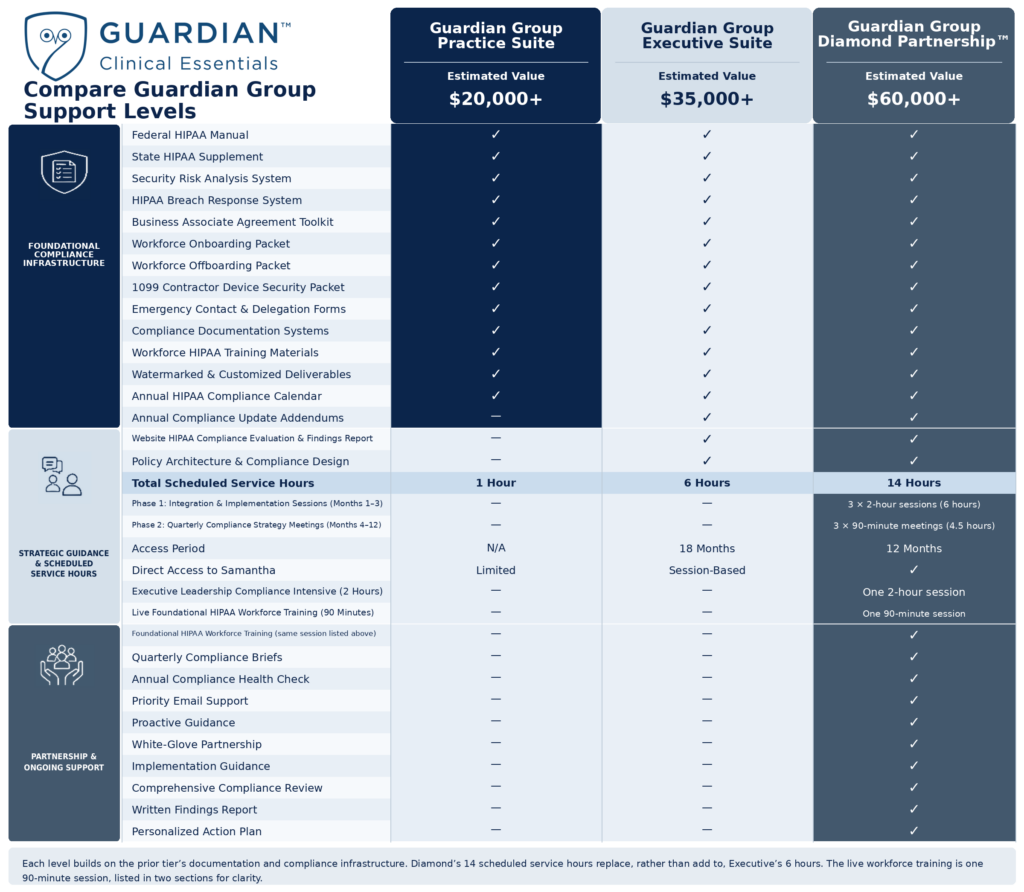
Guardian Group Executive Compliance Suite™
For organizations seeking executive-level guidance, strategic support, and a comprehensive compliance infrastructure without a year-long partnership.
Guardian Group Diamond Compliance Partnership™
For organizations seeking a concierge-level compliance partnership with executive guidance, workforce support, and year-long access to a trusted advisor.