
ADA Website Law: What Therapists Are Misunderstanding
There is a lot of confusion right now about what changes in April 2026 and whether it applies to private practices.
Here is what actually matters, and where therapists are still at risk.
If you’ve been hearing that there’s a new ADA law going into effect in April that requires therapists to update their websites, you’re not alone.
This has been circulating quite a bit lately, and understandably, it’s creating confusion.
Let’s clear that up.
Because while there is a real update, it’s not being explained accurately in most places right now. And more importantly, therapists are focusing on the wrong part of the conversation.
What Actually Changed
In April 2024, the Department of Justice finalized an update under the ADA.[1]
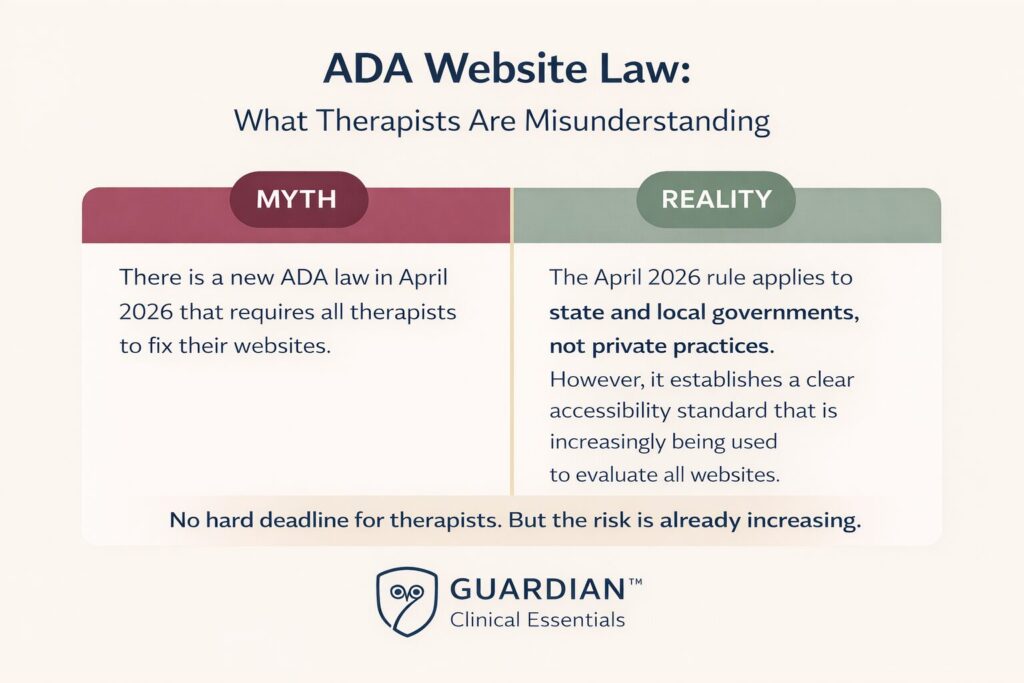
This update applies specifically to Title II, which covers state and local government entities.
The ADA is divided into different sections called “Titles.” Title II applies to state and local government entities, while Title III applies to private businesses, including most private practices.
This distinction is what creates much of the confusion around the 2026 rule.
For the first time, the federal government clearly defined what “accessible” means for websites. Those entities are now required to meet WCAG 2.1 Level AA standards, with compliance deadlines starting in April 2026.[1]
That part is real. And it’s important.
Where the Confusion Is Coming From
The issue is that this rule is being talked about as if it applies to everyone.
It doesn’t.
Most therapists and private practices fall under Title III, which applies to private businesses. That section of the ADA has not been updated with a new rule or deadline.[2]
So no, therapists are not suddenly required to overhaul their websites by April 2026.
There are limited situations where this can extend beyond public entities. If a private practice or organization is contracted to provide services as part of a government program, accessibility expectations may apply to how those services are delivered, including digital access points. This does not automatically mean the entire practice is treated as a public entity, but it can affect specific programs or services connected to that role.
But This Still Matters More Than People Think
Even though this rule does not directly apply to private practices, it does something significant.
It establishes a clear national standard for what accessibility looks like.
And that changes the landscape.
Until now, ADA website cases have existed without a clearly defined technical benchmark. This update fills that gap. It gives structure to what “accessible” means, which makes expectations more consistent and easier to evaluate over time.
Where Therapists Actually Have Risk
This is the part that often gets overlooked.
Your website is not just a marketing tool. It is part of how clients access your services, communicate with you, and interact with your practice.
That’s where the risk actually starts.
If your website allows potential clients to submit information, you may be collecting protected health information without even realizing it. If your communication methods are not secure or clearly explained, that creates additional exposure. This often includes missing or incomplete required disclosures, such as a Notice of Privacy Practices.
Many therapists also rely on website templates or EHR-built pages and assume compliance has already been handled. It is important not to assume a platform or designer has addressed accessibility or privacy requirements on your behalf.
It hasn’t.
Accessibility, privacy, and compliance are not automatically built into those systems. They still require intentional review and decision-making on your end.
What Accessibility Actually Means
Accessibility is not about making your website perfect. It is about making it usable.
That includes whether someone can navigate your site without a mouse, whether your text is readable, and whether your forms can be completed using assistive technology.
These are practical elements that directly affect how someone experiences your website.
A helpful place to start is usability. If someone cannot easily read, navigate, or complete a form on your site, that is where attention is needed first.
What This Actually Means for Therapists
There is no new ADA requirement that forces therapists to update their websites by April 2026.
However, accessibility is becoming more clearly defined at the federal level, and that standard is increasingly being used to evaluate websites across industries.
This means the expectation is shifting, even without a direct mandate.
What to Do From Here
There is no reason to panic.
But this is also not something to ignore.
A reasonable approach is to start by looking at how your website functions. How does it collect information? How do people contact you? Are there any obvious barriers to usability?
From there, you can begin making improvements, starting with the areas that carry the most risk.
And most importantly, do not assume your website is compliant simply because it exists or was built by someone else.
You do not need to fix everything at once. Focusing on the areas that carry the most risk is a practical place to begin. In many cases, this includes reviewing contact forms, communication methods, privacy disclosures, and how your website can be accessed and navigated by different users.
Want a Quick Reference Version?
If you want a simplified version of this breakdown that you can save or refer back to, you can download a one-page summary here:
Download the ADA Website Compliance Quick Guide
This is a quick reference guide you can save and come back to.
Final Thought
There is no sudden ADA deadline for therapists in April.
But there is a shift happening.
Accessibility is becoming more clearly defined, more consistently discussed, and more closely tied to how compliance is evaluated across the board.
That shift is what actually matters.[3]
Stay Updated on Compliance Changes
Compliance expectations are constantly evolving, and most providers don’t hear about changes until they become a problem.
If you want clear, practical updates you can actually use, you can join my email list below.
If You Want a Structured Review of Your Website
If you’re not sure where your website stands, or what actually needs attention, a structured compliance review can help identify gaps without guessing.
The Website HIPAA Compliance Evaluation & Report provides a detailed review of your website, including:
- Accessibility considerations
- Communication and contact risks
- HIPAA and privacy exposures
- Required disclosures and policy gaps
This allows you to see exactly where your website may fall short and what steps to take next.
Sources
[1] U.S. Department of Justice. Accessibility of Web Information and Services of State and Local Government Entities (2024 Final Rule). https://www.ada.gov/resources/2024-03-08-web-rule/
[2] U.S. Department of Justice. Guidance on Web Accessibility and the ADA. https://www.ada.gov/resources/web-guidance/
[3] U.S. Department of Justice. Accessibility of Web Information and Services (Fact Sheet). https://www.ada.gov/resources/2024-03-08-web-rule/
About the Author
Samantha Schalk, LMSW-C, LMSW-M, CAADC, CIMHP, BCP3, CHPSE
Samantha is a licensed mental health professional, private and group practice owner, Certified HIPAA Privacy Security Expert (CHPSE), and the founder of Guardian Clinical Essentials™.
Her work focuses on helping therapists and behavioral health practices understand and implement requirements involving HIPAA, privacy, security, documentation, technology, and practice operations.
Drawing from her experience in clinical practice, supervision, practice ownership, and compliance consulting, Samantha develops practical compliance resources, training, and implementation guidance specifically for behavioral health professionals.
Learn more about Samantha and Guardian Clinical Essentials™.

Related HIPAA Resources
If you want to better understand how these issues connect to your practice, these may be helpful: