
2026 HIPAA Privacy Rule Changes:
What Therapists and Group Practice Owners Need to Know
Published November 23, 2026
Well, HIPAA has some news for us. Because apparently, fulfilling a records request within 30 days was a bit too leisurely, and we needed a tighter deadline to keep us on our toes. Keep the coffee flowing!
On November 16, 2026, the U.S. Department of Health and Human Services (HHS) announced significant changes to the HIPAA Privacy Rule. The final rule was published in the Federal Register on November 19, 2026, and several of these changes will directly affect how we operate our therapy practices.
If you’ve been following the proposed HIPAA Security Rule changes, this is a different regulation. And that distinction matters because the Privacy Rule changes have been finalized, while the separate Security Rule proposal has its own regulatory process.
Some of these changes will affect things you probably deal with regularly, such as responding to a client’s request for records or communicating with another provider. Others may have you taking a closer look at your Notice of Privacy Practices, how your EHR handles electronic records, or whether your current procedures can accommodate a much shorter response deadline.
And because we’re talking about behavioral health, we also need to consider psychotherapy notes, state confidentiality laws, substance use disorder records, and the circumstances in which information can be shared without a client’s authorization.
Before you start panic Googling, let’s sort through what has changed, who it applies to, and what deserves attention between now and July 2027.
What Are the New HIPAA Privacy Rule Changes for 2026?
The new rule is officially titled HIPAA Privacy Rule: Changes to Support Coordinated Care and Individual Engagement and Reduce Regulatory Burdens. It is the culmination of a regulatory process that began with proposed changes in 2021.
And I have to say, some of these changes are overdue.
Clients should be able to access their health information without unnecessary obstacles. Providers should be able to coordinate care without treating every routine communication as though it requires a legal consultation. And if an administrative requirement doesn’t meaningfully protect anyone’s privacy, why are we continuing to do it?
Of course, implementing these changes looks a little different when you don’t have an entire department dedicated to medical records, compliance, and information technology.
The final rule addresses several major areas:
Shorter deadlines for responding to records access requests.
Electronic records access, including personal health applications and designated third parties.
Records fees and fee transparency.
Notice of Privacy Practices requirements.
Information sharing for care coordination and case management.
Identity verification procedures.
Certain business associate requirements and transition provisions.
The full regulation is available in the November 19, 2026 Federal Register publication, along with the 2026 Privacy Final Rule overview published by HHS.
Strap in, we’re about to get to the nitty-gritty.
When Does the 2026 HIPAA Privacy Rule Take Effect?
Circle these dates on your calendar:
January 19, 2027: The rule becomes effective.
July 19, 2027: The general deadline for compliance with the new requirements.
There’s a limited exception for certain business associate agreements, which I’ll discuss later.
We’re not pressing pause on HIPAA until July. Current requirements and applicable state laws still apply.
Use these months to get your processes straight, not to invent a brand-new paperwork pile nobody can follow.
The 2026 HIPAA Privacy Rule: What Therapists Need to Know
15 calendar days: Shorter response deadline for records access requests.
Electronic records: Expanded access rights and revised fee requirements.
Website requirements: Greater transparency regarding records fees.
Notice of Privacy Practices: Updated content requirements and elimination of the federal written acknowledgment requirement.
Care coordination: Expanded permissions for certain disclosures.
Practice operations: Updates to applicable policies, procedures, and workforce training.
Remember: State confidentiality, privacy, and security laws still matter, even if your practice does not qualify as a HIPAA covered entity.
HIPAA Medical Records Requests: The New 15-Day Access Deadline
This is probably the change that will get the most attention from therapists.
Under the existing federal HIPAA Privacy Rule, covered entities generally have up to 30 calendar days to respond to an individual’s request for access to protected health information (PHI). That initial response period will be cut in half, with requests requiring action as soon as practicable, but no later than 15 calendar days after receipt.
And yes, calendar days. Not business days.
I appreciate the reasoning behind this change. Clients shouldn’t have to wait a month for information they’re legally entitled to access, particularly when it’s necessary for continuing treatment, obtaining benefits, or making decisions about their care.
But I also know what running a therapy practice looks like.
Imagine receiving a records request on a Friday afternoon, immediately before leaving for a weeklong vacation. The calendar doesn’t stop because you’re out of the office, and the deadline doesn’t wait for you to finish unpacking when you get home.
If your current process depends on remembering to check an email or getting around to a request when you have a free afternoon, we may need to rethink that approach.
Can Therapists Extend the 15-Day HIPAA Records Deadline?
Yes, but the extension is not automatic.
The final rule retains the opportunity for one extension of up to 30 additional calendar days. You must notify the individual in writing within the initial response period, explain the reason for the delay, and identify when the request will be completed.
That doesn’t mean 45 days becomes your standard turnaround time.
Group practice owners, who handles records requests when a clinician is on vacation, leaves your practice, or is otherwise unavailable?
Solo practitioners, what happens when you’re sick, traveling, or dealing with an unexpected emergency?
Your records access procedures need to function even when you can’t.
Do State Laws Require Faster Access to Therapy Records?
They certainly can.
Some states have their own deadlines, procedures, and restrictions involving mental health records. Where those requirements provide greater access rights or otherwise remain applicable under HIPAA’s preemption provisions, they must still be followed.
The new Privacy Rule also clarifies the importance of complying with shorter response timeframes required by other applicable federal or state laws.
If you provide telehealth services across state lines or operate a group practice with clinicians licensed in multiple states, don’t assume one set of records access procedures will address every applicable requirement.
After all, not all states agree, and some of their requirements may even conflict with one another.
HIPAA Psychotherapy Notes vs. Progress Notes: What Can Clients Access?
Now we get into an area where I expect plenty of confusion.
A client requesting their records does not automatically mean they’re entitled to every document you’ve ever written about them. But you also can’t withhold ordinary clinical documentation simply because it contains sensitive information.
Under HIPAA, psychotherapy notes have a very specific definition. They are notes recorded by a mental health professional documenting or analyzing the contents of conversations during private, group, joint, or family counseling sessions and maintained separately from the rest of the individual’s medical record.
HIPAA specifically excludes medication information, session start and stop times, treatment modalities and frequencies, clinical test results, and summaries of diagnosis, functional status, treatment plans, symptoms, prognosis, and progress from that definition.
And no, calling your progress note a psychotherapy note doesn’t magically make it one.
Properly defined psychotherapy notes remain excluded from HIPAA’s individual right of access and generally require client authorization before disclosure, with limited exceptions. Applicable state laws must also be considered.
Here’s something that can get overlooked in group practices: Just because a client transfers from one therapist to another within the same practice doesn’t mean the new therapist automatically gets access to the former therapist’s psychotherapy notes.
This may require additional safeguards within your practice. And depending on your EHR, you may find yourself navigating a technological obstacle course designed by someone who has clearly never worked in a therapy practice.
You can review the federal definition of psychotherapy notes and the individual right of access provisions for additional information.
New HIPAA Electronic Health Records Access Requirements
Clients increasingly use portals, applications, and other digital tools to access their healthcare information. The new rule clarifies certain electronic access rights and the formats in which information must be provided.
Before anyone starts shopping for a new EHR, that’s not necessarily what you need.
What you do need is an understanding of your existing system’s capabilities.
If you’re using SimplePractice or another behavioral health EHR, do you know what your clients can access through their portals? What formats can you export records in? Can you appropriately exclude separately maintained psychotherapy notes from those exports?
Don’t assume your EHR vendor has taken care of every legal requirement simply because the platform advertises HIPAA compliance.
They provide the technology. You’re still responsible for how your practice uses it.
Can Clients Request Records Through Personal Health Apps?
The final rule addresses access through personal health applications when a covered entity can provide electronic information in the requested form and format.
Applications such as Apple Health and Oura illustrate how consumer health technology continues to evolve. Although their capabilities and integrations with behavioral health EHRs vary, we may encounter more requests involving these types of applications.
That doesn’t mean you’re required to purchase new technology or establish integrations with them.
However, a personal health app selected by a client isn’t necessarily subject to HIPAA simply because it handles health information.
The protections governing information after it reaches a consumer application may differ from those governing the information in your practice. Your responsibilities for appropriately safeguarding the information during transmission still apply.
Given the sensitivity of behavioral health records, that’s a distinction worth understanding.
Can Clients Direct Their Electronic Records to Another Person?
The final rule addresses an individual’s right to direct an electronic copy of PHI maintained in an electronic health record to someone they designate.
This is not a blanket requirement to send every document you maintain to any third party under identical procedures.
A client exercising their right to direct electronic records to another person is not the same as a client signing an authorization permitting the disclosure of information. Different requirements may apply, including those involving fees.
The nature of the request, the information involved, the applicable legal authority, and additional confidentiality restrictions still matter.
These requests must be clear and specific, including identifying the intended recipient and where the information should be sent. Your practice may require requests to be submitted in writing, including electronically, provided you’ve informed clients of that requirement.
The new 15-calendar-day deadline and applicable extension provisions also apply to qualifying requests.
I’d pay particular attention to requests involving attorneys, family members, schools, and employers.
A client’s right to access their records and the rules governing disclosures to third parties overlap, but they aren’t always the same thing.
HIPAA Medical Records Fees: What Can Therapists Charge in 2027?
Well, before you start calculating how much of your Saturday you’re going to lose preparing a client’s records, we need to talk about what you’re legally allowed to charge for that time.
HIPAA has never given therapists free rein to charge whatever they want for providing clients with access to their records. The new rule further addresses permissible fees, including circumstances in which electronic records must be provided without charge.
And no, just because your clinical hourly rate is $200 doesn’t mean you can charge $200 for an hour spent preparing a client’s records.
I know, I know. Apparently, our administrative time operates in an entirely different economic universe.
Who’s requesting the records matters, too. A client requesting their own records, a client directing electronic records to another person, and an attorney requesting records with a valid authorization may be subject to different fee requirements.
Under the new rule, you cannot charge clients to inspect their records or to access their electronic PHI through an internet-based method, such as a client portal or personal health application.
That doesn’t mean every request for an electronic copy must be fulfilled without charge. How the information is being accessed matters.
Where HIPAA permits a reasonable, cost-based access fee, allowable expenses are limited to applicable copying labor, supplies for non-electronic copies, applicable postage when mailing is requested, and preparation of a summary or explanation when the client has agreed to it and the associated fee in advance.
Searching for and retrieving records cannot simply be added to an individual’s HIPAA access fee.
Nor can you withhold records to which a client has a HIPAA right of access because they have an outstanding therapy bill.
Before revising your fee schedule, review both federal and applicable state requirements.
Your practice policies don’t get to override either one, no matter how beautifully you’ve formatted them.
Do Therapy Practices Have to Post Records Fees on Their Websites?
Well, it looks like we have another item to add to our website to-do list.
Under the new rule, if your practice charges for copies of PHI, you’ll need to make your estimated records fee schedule publicly available on your website, if you have one, at the point of service, and upon request.
Your fee schedule must identify the types of access available free of charge and the applicable standard or estimated fees for records requests, including requests made under an individual’s right of access, requests directing electronic records to another person, and disclosures made with a valid authorization.
Preferably somewhere clients can find it without having to launch a search party.
Posting your fee schedule doesn’t eliminate your responsibility to provide advance notice of applicable fees when required.
I’d also review any existing forms containing records fees. If your website says one thing, your authorization form says something different, and your office manager has a third fee schedule, we’ve created ourselves a compliance scavenger hunt.
And remember, posting a fee schedule isn’t a substitute for having appropriate records access policies and procedures.
2026 HIPAA Notice of Privacy Practices Changes
Here’s one change that may deserve an enthusiastic “It’s about time!”
Under the new rule, covered healthcare providers with direct treatment relationships will no longer be federally required to make a good-faith effort to obtain written acknowledgment that a client received their Notice of Privacy Practices (NPP).
For years, we’ve been asking clients to sign or check yet another box as part of their intake paperwork.
While we may be able to eliminate that acknowledgment, the NPP itself isn’t going anywhere.
The new rule also changes what our notices must include about clients’ privacy rights, how they can exercise those rights, and their right to discuss the notice with a designated contact person or office.
We’ll need to review the prominent introductory language in our notices, how we explain the updated records access rights and applicable fees, and the required contact information, including a telephone number and email address for the designated contact person or office.
For those providing services in correctional settings, the final rule also removes the previous exception concerning incarcerated individuals’ right to receive an NPP.
A little less paperwork? Possibly. An NPP that needs updating? Yep.
Do Therapists Still Need Signed HIPAA Privacy Notice Acknowledgments?
I wouldn’t rush to delete that form from your intake paperwork just yet.
Depending on where you practice, you may have additional state requirements or other reasons to document that a client received your NPP.
Acknowledging receipt of your NPP is also not the same as signing an informed consent, consenting to treatment, authorizing the disclosure of information, or agreeing to your financial policies.
If you’ve combined several of these into one intake document, please review the entire form before removing anything.
And yes, I’ll be updating the GCE Notice of Privacy Practices to reflect the new requirements. So, if you’re looking at your current NPP wondering what on earth needs to change, I’ll have you covered.
And if y’all would rather have me handle it for you, that’s an option, too. Just send me an email to get on the waitlist. 😉
How Do the New HIPAA Notice Requirements Affect 42 CFR Part 2?
HIPAA and 42 CFR Part 2 are separate federal regulations.
Part 2 provides additional confidentiality protections for certain substance use disorder treatment records, and those protections aren’t going away with the new HIPAA Privacy Rule.
If your practice is subject to Part 2, you’ll need to consider both regulations when reviewing your privacy notices, consent procedures, and disclosures.
And don’t confuse the compliance deadlines. The February 16, 2026 compliance deadline for the 2024 Part 2 changes is separate from the July 19, 2027 deadline for the new HIPAA Privacy Rule.
If your practice was already required to update its NPP by February 16, 2026, those requirements haven’t been postponed.
Not every therapist treating a client with a substance use disorder qualifies as a Part 2 program. Applicability depends on several factors, including the nature of the program, its services, and federal assistance. Additional considerations may apply when receiving Part 2 records from another provider.
If you provide substance use disorder treatment services, I’d encourage you to determine whether Part 2 applies to your practice before revising your NPP.
You can learn more about the applicable Part 2 requirements in my article, February 2026 Substance Use Confidentiality Update for Therapists.
HIPAA Care Coordination Rules: Sharing Client Information Without Authorization
As therapists, we know our clients’ needs extend well beyond what happens during a therapy session.
Housing instability, transportation difficulties, food insecurity, and access to community resources can significantly affect our clients’ mental health and daily functioning.
The final rule expressly permits certain disclosures to social service agencies, community organizations, home and community-based service providers, and similar organizations that provide health-related services to support individual care coordination and case management.
I appreciate this change. Helping our clients access appropriate services shouldn’t involve unnecessary administrative obstacles.
But just because HIPAA permits a disclosure does not necessarily mean it is clinically appropriate or legally permissible under other applicable laws.
Imagine you’re working with a client experiencing housing instability. You’ve identified a community organization that may be able to help them secure temporary housing.
What information does that organization need?
Their contact information and a brief explanation of their current circumstances may be sufficient.
Does the organization need a detailed account of their last six therapy sessions, their trauma history, and their entire treatment record?
Probably not.
Our clinical judgment, ethical responsibilities, applicable confidentiality laws, and respect for client autonomy still matter.
Does the HIPAA Minimum Necessary Standard Still Apply?
Yes.
The original 2021 proposal included an additional exception to the minimum necessary standard for certain care coordination and case management activities. That proposed exception was not finalized.
Where the minimum necessary standard applies, we must continue making reasonable efforts to limit information to what is needed for the intended purpose. Existing exceptions, including disclosures to or requests by healthcare providers for treatment, remain relevant.
There is a difference between what we are legally permitted to disclose, what we are legally required to disclose, and what is clinically appropriate to disclose.
Those are three different questions, and sometimes they have three different answers.
Can Therapists Share Information With Family Members and Caregivers?
HIPAA already allows certain disclosures to individuals involved in a client’s care or payment for care, subject to specific conditions.
The new rule doesn’t give us blanket permission to discuss our clients’ treatment with family members.
A client’s spouse calling to ask how therapy is going isn’t automatically entitled to information simply because they’re married.
And when a parent requests information about an adolescent’s treatment, we may also be navigating minor consent laws, parental access rights, custody arrangements, and confidentiality protections.
Family involvement can be an important part of treatment. It can also be clinically complicated.
The new rule doesn’t change that.
Did HIPAA Change the Serious and Imminent Threat Standard?
The 2021 proposal would have modified HIPAA’s serious and imminent threat standard to include certain serious and reasonably foreseeable threats.
That proposed change was not finalized.
Therapists should continue evaluating disclosures involving threats of harm under existing HIPAA requirements, applicable state duty-to-warn or duty-to-protect laws, mandatory reporting obligations, and other relevant legal and professional responsibilities.
HIPAA Identity Verification Requirements for Patient Records Requests
HIPAA has long required covered entities to verify someone’s identity and authority to receive PHI when appropriate. The new rule addresses unnecessary barriers within that process.
Imagine a former telehealth client who now lives several hours away. Your practice requires them to appear in person with their driver’s license before you’ll process their records request.
Is that really the only reasonable way you could verify their identity?
Depending on the circumstances, there may be other secure options that don’t require your former client to spend an entire day traveling to your office.
We’re not eliminating identity verification. We’re eliminating unnecessary obstacles.
And remember, verifying someone’s identity does not necessarily establish their legal authority to receive the information.
Does the 2026 HIPAA Privacy Rule Apply to Private-Pay Therapists?
I spend a fair amount of time talking with clinicians about this, and somehow, the confusion surrounding private-pay practices and HIPAA persists.
Being a private-pay therapist does not automatically exempt you from HIPAA.
Whether a healthcare provider qualifies as a HIPAA covered entity generally depends on whether the provider conducts certain covered electronic transactions, directly or through another party.
It isn’t determined solely by whether you accept insurance, have an NPI, or use a HIPAA-compliant EHR.
And if your practice isn’t a HIPAA covered entity, you still have privacy, confidentiality, and information security responsibilities.
State laws, professional licensing requirements, ethical standards, contractual obligations, and other applicable regulations may impose significant requirements.
There are two separate questions I encourage every therapist to ask:
Does my practice qualify as a HIPAA covered entity?
Regardless of whether HIPAA applies, what privacy, confidentiality, records access, and information security requirements govern my practice?
Answering the first question doesn’t get you out of answering the second.
How Do State Mental Health Confidentiality Laws Affect HIPAA Compliance?
If you’ve followed my work for any length of time, you probably knew this section was coming.
One of the biggest mistakes I see behavioral health professionals make is assuming HIPAA addresses the entirety of their legal obligations surrounding client confidentiality.
It doesn’t.
State laws can establish additional requirements involving mental health records, minors’ records, privileged communications, authorizations, retention, information security, and breach notification.
Under HIPAA’s preemption provisions, certain conflicting state laws may be preempted, but there are important exceptions, including certain laws providing stronger privacy protections.
And in many situations, there isn’t a conflict at all. You can comply with both.
For example, HIPAA may permit a disclosure to another healthcare provider for treatment, while your state’s mental health confidentiality law requires client authorization.
If you rely solely on HIPAA’s permission, you could find yourself violating state law.
This is why I’m cautious about generic practice forms and policies marketed to therapists across the country.
It’s also why GCE offers state-specific HIPAA compliance supplements. A federal HIPAA manual provides an important foundation, but it doesn’t replace the need to understand the laws governing your practice.
Can Parents Access Their Minor Child’s Therapy Records?
Not always.
HIPAA generally recognizes parents as personal representatives of their unemancipated minor children in many circumstances, but there are important exceptions.
For example, when a minor can legally consent to certain mental health services without parental permission, the rules governing parental access may differ from those governing other healthcare records.
Throw custody arrangements, court orders, abuse or neglect concerns, and applicable state laws into the mix, and things can get complicated rather quickly.
I’d discourage practices from adopting blanket policies that either grant or deny parents access to all minor client records.
A shorter records access deadline doesn’t resolve those underlying questions. We still need to determine who’s legally entitled to access the information and what information they’re entitled to receive.
HIPAA Business Associate Agreement Changes and 2027 Deadlines
The final rule provides a limited transition period for certain qualifying business associate agreements (BAAs).
To qualify, an existing agreement must meet the applicable regulatory conditions, including having been established and compliant with the applicable requirements before November 19, 2026, and not having been renewed or modified during the specified transition period between January 19 and July 19, 2027.
Qualifying agreements may remain in place under the transition provisions until they are renewed or modified on or after July 19, 2027, or until January 18, 2028, whichever occurs first.
Before relying on that additional time, review the specific eligibility conditions in the final rule. Not every existing agreement automatically qualifies.
This additional time applies to qualifying contractual requirements. It does not extend your practice’s deadline for fulfilling clients’ records access requests.
I’d also use this opportunity to evaluate your vendor relationships.
Who maintains client information on your behalf? Which vendors require BAAs? Have you obtained them? Do those agreements appropriately address the services being provided?
With the shorter records access deadline, I’d particularly want to know how quickly my business associates can assist me in retrieving information.
After all, your vendor’s customer support response time doesn’t reset your compliance deadline.
Other Privacy Rule Changes Worth Knowing About
The final rule also addresses qualifying telecommunications relay services for individuals who are deaf, hard of hearing, deaf-blind, or who have a speech disability. It permits certain disclosures to communications assistants and removes the BAA requirement for qualifying relay service providers.
This is not a blanket exemption for interpretation services, transcription platforms, or AI documentation tools.
Additional disclosure permissions involving military command authorities are also extended to members of the U.S. Public Health Service and NOAA Commissioned Corps for applicable mission-readiness purposes.
Depending on the populations you serve, these changes may warrant a closer look.
What Hasn’t Changed Under the 2026 HIPAA Privacy Rule?
With all this discussion about what’s changing, let’s not lose sight of what isn’t.
HIPAA’s underlying privacy protections, special protections for psychotherapy notes, applicable state laws, and Part 2 confidentiality requirements remain relevant.
You still need appropriate safeguards, workforce training, documented policies and procedures, BAAs where required, and an applicable HIPAA Security Risk Analysis.
Also, HHS didn’t adopt every change from the 2021 proposal. Be careful about relying on older articles describing proposed requirements as though they were included in the final rule.
2026 HIPAA Privacy Rule vs. Proposed HIPAA Security Rule Changes
These are separate regulatory actions.
The Privacy Rule primarily addresses how PHI may be used and disclosed, individuals’ rights regarding their information, and associated privacy obligations.
The Security Rule addresses the administrative, physical, and technical safeguards necessary to protect electronic PHI.
For example, responding appropriately to a client’s records request involves Privacy Rule requirements. Protecting those electronic records while storing, preparing, and transmitting them also involves Security Rule requirements.
This is why I encourage practices to approach compliance as an interconnected system rather than a collection of independent forms and documents.
For now, don’t confuse the proposed Security Rule changes with the finalized Privacy Rule requirements discussed here.
Who has time to track every new AI, HIPAA, and privacy law? Apparently, I do. And I love it!
Sign up for the Guardian Clinical Essentials newsletter and get important compliance updates for behavioral health practices delivered straight to your inbox. No fluff, just the developments worth knowing about.
HIPAA Privacy Rule Compliance Checklist for Therapists and Group Practices
So, what should you be doing between now and July 19, 2027?
I’d begin by evaluating your existing practices rather than immediately rewriting everything.
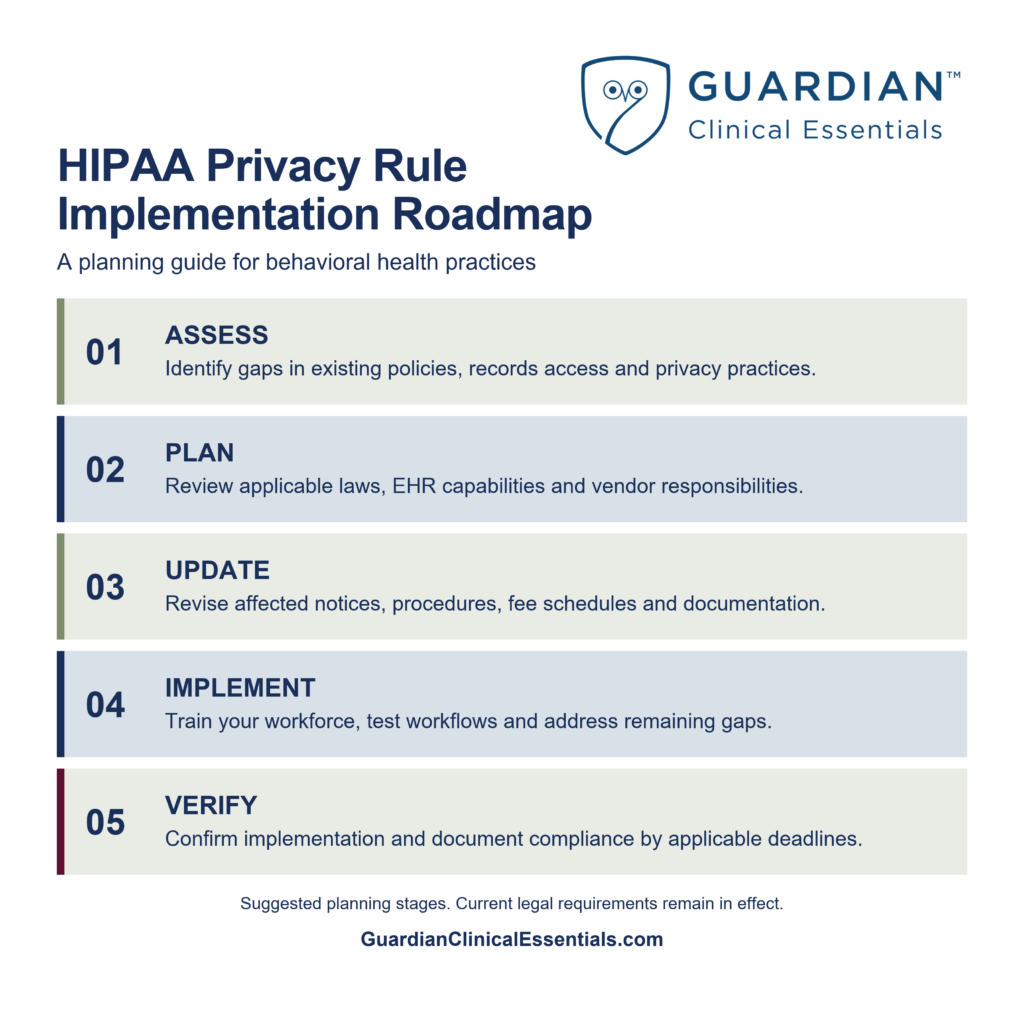
The suggested timeline provides a manageable approach to preparing for the new requirements. These are recommended planning milestones, not additional federally mandated deadlines.
Here are ten areas I’d prioritize:
Records access procedures: Review how requests are received, documented, tracked, and fulfilled under the shorter deadline.
Contingency planning: Establish coverage during vacations, illness, emergencies, and clinician departures.
Electronic records capabilities: Review EHR exports, portal access, third-party requests, and psychotherapy note safeguards.
Records fee schedules: Evaluate permissible fees, circumstances requiring free access, and fee reporting and transparency requirements.
Notice of Privacy Practices: Revise your notices and establish procedures for making updated versions available.
Intake documentation: Determine whether NPP acknowledgment forms should be retained, revised, or removed.
Care coordination procedures: Review disclosures involving other providers, community organizations, and individuals involved in a client’s care.
State and specialty requirements: Evaluate applicable state laws, minor consent requirements, and Part 2 protections.
Business associate agreements: Review vendor relationships, contractual responsibilities, and eligibility for additional transition time.
Workforce training: Educate clinicians and administrative staff about revised requirements and their individual responsibilities.
Group practice owners, I’d also evaluate how consistently these procedures are implemented.
Having six clinicians who each have a different understanding of your records release procedures isn’t ideal, even if all six have signed an acknowledgment that they’ve read the HIPAA manual.
And please, whatever you do, don’t confuse downloading an updated template with implementing a compliant procedure.
Those are two different things.
Preparing Your Therapy Practice for the July 2027 HIPAA Deadline
There is a lot to unpack here, but I don’t think the appropriate response is to panic and start replacing every document in your practice.
Some of these changes are genuinely positive. Implementing them, however, requires more than knowing a new regulation exists.
One of the things I’ve learned over the years is that when we start examining one compliance concern, we frequently discover several others that need attention.
The new Privacy Rule may be what prompted you to review your practice, but I wouldn’t limit that review exclusively to the new requirements.
If you’re unsure where your practice currently stands, my complimentary HIPAA Check-In for Your Therapy Practice can help you begin identifying areas that deserve a closer look.
And if you need more individualized assistance, Guardian Clinical Essentials offers HIPAA compliance reviews, practice documentation, state-specific compliance resources, and private consulting services for solo therapists and group practices.
Whether you’re trying to figure out what needs to change in your NPP or how on earth you’re going to implement all of this across an entire group practice, you don’t have to figure it out on your own.
Start now. Identify what needs to change and develop a manageable implementation plan rather than waiting until July to discover your current processes aren’t quite up to the task.
I’ll continue providing education, resources, and updates as we move toward the new compliance deadline.
Because apparently, HIPAA isn’t quite finished keeping us busy.
At least we have coffee.
And remember, you can always tap me in for consulting if you need help determining what these changes mean for your practice and how to implement them.
Frequently Asked Questions
About the 2026 HIPAA Privacy Rule
Is the new HIPAA Privacy Rule final?
Yes. HHS announced the final rule on November 16, 2026, and it was published in the Federal Register on November 19, 2026.
When do therapists have to comply?
The effective date is January 19, 2027, with a general compliance deadline of July 19, 2027. Certain qualifying BAAs have a limited additional transition period.
Is the new records request deadline 15 business days?
No. The initial federal deadline is 15 calendar days, although applicable state laws may require a faster response. One additional extension of up to 30 calendar days is permitted when specified conditions are met.
Can therapists charge clients for electronic records?
It depends on how the information is requested and accessed. Covered entities cannot charge clients for inspecting their PHI or accessing electronic PHI through an applicable internet-based method, such as a client portal or personal health application. Certain other requests may be subject to reasonable, cost-based fees. Applicable state laws must also be considered.
Do therapists have to post records fees on their websites?
Under the new rule, covered entities charging for copies of PHI must make applicable estimated fee schedules available on their websites, if they maintain one, at the point of service, and upon request. Advance notice of applicable fees is also required in specified circumstances.
Do therapists have to provide psychotherapy notes?
Properly defined and separately maintained psychotherapy notes remain excluded from HIPAA’s individual right of access. Ordinary progress notes are not automatically excluded. Applicable state laws may establish additional rights.
Do therapists need to update their Notice of Privacy Practices?
Covered entities subject to the revised notice requirements will need to update their NPPs. Eliminating the federal acknowledgment requirement does not eliminate the requirement to provide the notice.
Does the new HIPAA rule apply to private-pay therapists?
Potentially. Private-pay status alone does not determine HIPAA applicability. Other privacy, confidentiality, and security requirements may apply regardless of covered entity status.
Can therapists coordinate care without client authorization?
HIPAA permits certain disclosures without authorization, including specified care coordination activities. Applicable state laws, Part 2 protections, and other legal requirements may restrict those disclosures.
Do therapists need new business associate agreements?
Some existing agreements may require revision. Certain qualifying agreements are eligible for a limited transition period ending no later than January 18, 2028, subject to the applicable renewal and modification provisions. This does not extend the general July 19, 2027 compliance deadline for other requirements.
Guardian Clinical Essentials™ provides behavioral health practices with customized compliance documentation, HIPAA resources, and consulting services addressing privacy, security, vendor management, and emerging technology requirements.
This article is provided for educational and informational purposes and does not constitute legal advice. Practices should evaluate the laws, licensing requirements, professional standards, and technology applicable to their specific operations.
Sources – Federal HIPAA Guidance
This article is based on federal HIPAA requirements and guidance from the U.S. Department of Health & Human Services.
- 2026 HIPAA Privacy Rule Final Rule, November 19, 2026, 91 FR 74848–74968
- 2026 HIPAA Privacy Rule Final Rule, Official PDF
- HHS 2026 Privacy Rule Final Rule Fact Sheet
- 45 CFR Part 164: Security and Privacy
- 45 CFR Part 160, Subpart B: Preemption of State Law
- 42 CFR Part 2: Confidentiality of Substance Use Disorder Patient Records
- HHS Fact Sheet: 2024 Confidentiality of Substance Use Disorder Patient Records Final Rule
About the Author
Samantha Schalk, LMSW-C, LMSW-M, CAADC, CIMHP, BCP3, CHPSE
Samantha is a licensed mental health professional, HIPAA Compliance Strategist, private and group practice owner, Certified HIPAA Privacy Security Expert (CHPSE), and the founder of Guardian Clinical Essentials™.
With 25 years of experience in behavioral health, her work focuses on helping therapists and behavioral health practices understand and implement requirements involving HIPAA, privacy, security, documentation, technology, and practice operations.
Drawing from her experience in clinical practice, supervision, practice ownership, and compliance consulting, Samantha develops practical compliance resources, professional training, and implementation guidance specifically for behavioral health professionals.
Learn more about Samantha and Guardian Clinical Essentials™.

Additional HIPAA Compliance Resources for Therapists
- Complimentary HIPAA Check-In for Your Therapy Practice
- HIPAA Compliance Reviews & Private Consulting
- HIPAA Security Risk Analysis for Therapists
- State-Specific HIPAA Compliance Supplements
- HIPAA Practice Documentation & Compliance Systems
- Website HIPAA Compliance Evaluation
- HIPAA Implementation & Client Support Services
- February 2026 Substance Use Confidentiality Update for Therapists
Interested in an updated Notice of Privacy Practices? Email me to join the waitlist.