HIPAA Documentation Requirements for Therapists: What Documentation Does a
Practice Actually Need?
Many therapists hear the word “documentation” and immediately think about clinical records.
Progress notes. Treatment plans. Intake paperwork. Releases of information.
Those documents certainly matter. They are an important part of both clinical care and regulatory compliance.
What often surprises therapists is that HIPAA documentation extends far beyond the client chart.
A practice may have excellent clinical documentation and still be missing significant portions of the documentation HIPAA expects to exist behind the scenes.
That distinction becomes important because HIPAA is not simply concerned with what happens during treatment. It is also concerned with how a practice protects protected health information, manages privacy and security risks, oversees vendors, trains staff, and makes operational decisions over time.
Documentation is the record of those activities.
In many ways, HIPAA documentation functions as the operational history of a practice.
Why Are Therapists Confused About HIPAA Documentation?
The confusion makes sense.
Most therapists are trained extensively on clinical documentation. Graduate programs, supervision, continuing education, and licensing boards all emphasize recordkeeping related to client care.
Very little attention is given to the operational side of compliance.
As a result, many therapists assume HIPAA documentation means having a Notice of Privacy Practices, maintaining client records, and using a secure electronic health record.
Those pieces are important, but they represent only part of the picture.
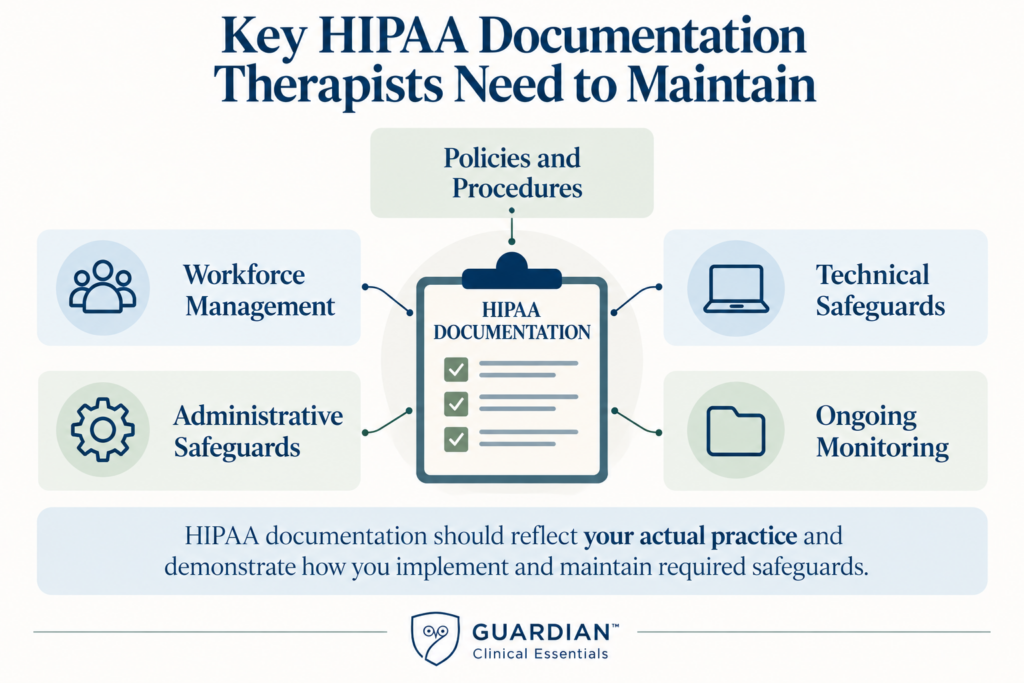
HIPAA documentation also includes the policies, procedures, decisions, assessments, training activities, and oversight processes that support privacy and security throughout the practice.
The challenge is that much of this documentation exists outside the clinical record, making it easier to overlook.
HIPAA documentation is not simply a collection of forms.
It is the operational record of how a practice protects information, manages risk, trains staff, oversees vendors, and supports privacy and security over time.
Is HIPAA Documentation the Same Thing as Clinical Documentation?
No.
Clinical documentation and HIPAA documentation serve different purposes.
Clinical documentation supports patient care, continuity of treatment, medical necessity, and professional recordkeeping.
HIPAA documentation reflects how a practice protects information and manages compliance responsibilities.
A useful way to think about it is that clinical records document what happened in treatment, while HIPAA documentation helps demonstrate how the practice protects the information connected to that treatment.
Both are important. They simply answer different questions.
What Types of Documentation Does HIPAA Require?
HIPAA documentation is not a single document or binder.
It is a collection of materials that together demonstrate how privacy and security responsibilities are managed throughout the practice.
The exact documentation may look different from one organization to another, but several categories consistently form the foundation of a compliant program.
Policies and Procedures
Written policies and procedures are often the starting point.
Policies translate HIPAA requirements into day-to-day practice operations. They help establish expectations for how protected health information is handled, who has access to information, how disclosures are managed, how incidents are addressed, and how privacy and security responsibilities are assigned.
One observation that comes up frequently in practice settings is that many operational decisions exist only in someone’s head.
A therapist knows how they handle records requests. A practice owner knows how staff are onboarded. An office manager understands the process for responding to client concerns.
The problem is that organizational knowledge and documented procedures are not the same thing.
Policies help create consistency, continuity, and accountability as practices evolve over time.
If you’re unsure whether your documentation would hold up if reviewed, this is a common gap.
Get notified when new compliance articles and resources are released.
Practical, therapist-focused guidance on HIPAA, state requirements, and digital privacy, centered on what actually matters for your practice.
Security Risk Analysis Documentation
For many therapy practices, this is one of the most significant documentation gaps.
The HIPAA Security Rule requires covered entities to conduct a Security Risk Analysis and evaluate potential risks and vulnerabilities related to electronic protected health information.
The assessment itself should be documented, but so should the decisions that follow.
Risk analysis is not simply an exercise in identifying problems.
It is an ongoing process of identifying, evaluating, and managing privacy and security risks through a documented Security Risk Analysis process, helping practices make informed compliance decisions over time.
A Security Risk Analysis often reveals that client information exists in far more places than therapists initially realize.
Email systems, websites, cloud storage platforms, telehealth systems, mobile devices, shared calendars, billing platforms, and practice management software may all play a role in how information moves through the practice.
Documentation helps demonstrate that those risks have been evaluated intentionally rather than assumed to be secure.
Vendor and Business Associate Documentation
Modern therapy practices rely on a growing number of external vendors.
Electronic health records, telehealth platforms, cloud storage systems, email providers, billing services, website providers, virtual assistants, and AI tools may all become part of the operational environment.
The question is often less about the technology itself and more about how the technology fits into the workflow.
Documentation helps demonstrate how vendor relationships are evaluated, what access vendors may have to protected health information, whether HIPAA Business Associate Agreements are required for vendors that create, receive, maintain, or transmit protected health information on behalf of a covered entity, and how oversight responsibilities are managed.
As technology ecosystems become more complex, this category of documentation becomes increasingly important.
Incident Response Documentation
Even well-managed practices occasionally encounter privacy or security concerns.
An email may be sent to the wrong recipient. A device may be lost. A security concern may require investigation.
Documentation helps create a record of how situations were evaluated, what actions were taken, and how decisions were made.
Not every incident becomes a reportable breach.
However, documenting the evaluation process demonstrates thoughtful oversight and helps establish consistency in how concerns are addressed.
Privacy and Security Decision Documentation
Some of the most valuable compliance documentation is created through routine decision-making.
Practices regularly evaluate new technologies, modify workflows, expand services, hire staff, implement telehealth systems, or change communication processes.
Those decisions often have privacy and security implications.
Documenting the reasoning behind significant decisions creates an operational record that can help support consistency, continuity, and defensibility over time.
Does a Solo Practice Need the Same Documentation as a Group Practice?
Not necessarily.
HIPAA allows practices to implement safeguards that are appropriate for their size, complexity, resources, and operational structure.
A solo practitioner typically has fewer staff, fewer access points, and fewer layers of oversight than a large group practice.
A multi-clinician organization may need additional documentation related to workforce management, role-based access controls, supervision structures, onboarding procedures, and internal communication processes.
The underlying principle remains the same.
Documentation should reflect how privacy and security responsibilities are actually managed within the practice’s specific environment.
How Long Should HIPAA Documentation Be Retained?
HIPAA generally requires certain documentation to be retained for six years from the date it was created or the date it was last in effect, whichever is later, as outlined in the HIPAA documentation retention requirements under 45 CFR §164.316(b)(2)(i).
This requirement often applies to policies, procedures, notices, training records, and other compliance-related documentation.
State laws and other regulatory requirements may impose additional retention obligations, so practices should evaluate retention requirements within the broader regulatory environment in which they operate.
Why Documentation Matters Even If You Are Never Audited
Most therapists will never experience a formal HIPAA audit.
That reality sometimes leads people to assume documentation is only important during an investigation.
In practice, documentation serves a much broader purpose.
It supports operational consistency. It helps guide decision-making. It creates continuity when staff change. It reduces uncertainty when unusual situations arise.
Most importantly, documentation helps transform compliance from a collection of assumptions into a system that can be understood, maintained, and improved over time.
HIPAA Documentation Is Really About Demonstrating How a Practice Operates
HIPAA documentation is not simply paperwork.
It is the written record of how a practice approaches privacy, security, oversight, and risk management.
The strongest compliance programs are rarely built on individual documents. They are built on operational systems that are documented, implemented, reviewed, and refined over time.
For therapists, understanding HIPAA documentation requirements is less about creating more paperwork and more about understanding how compliance is demonstrated throughout the life of a practice.
That shift in perspective often changes the conversation from “What forms do I need?” to “How does my practice actually manage privacy and security responsibilities?”
That is where HIPAA documentation becomes meaningful.
About the Author
Samantha Schalk, LMSW-C, LMSW-M, CAADC, CIMHP, BCP3, CHPSE
Samantha is a licensed mental health professional, private and group practice owner, Certified HIPAA Privacy Security Expert (CHPSE), and the founder of Guardian Clinical Essentials™.
Her work focuses on helping therapists and behavioral health practices understand and implement requirements involving HIPAA, privacy, security, documentation, technology, and practice operations.
Drawing from her experience in clinical practice, supervision, practice ownership, and compliance consulting, Samantha develops practical compliance resources, training, and implementation guidance specifically for behavioral health professionals.
Learn more about Samantha and Guardian Clinical Essentials™.