
Parental Consent for Mental Health Screenings:
What Changed in 2026?
Published: October 26, 2026
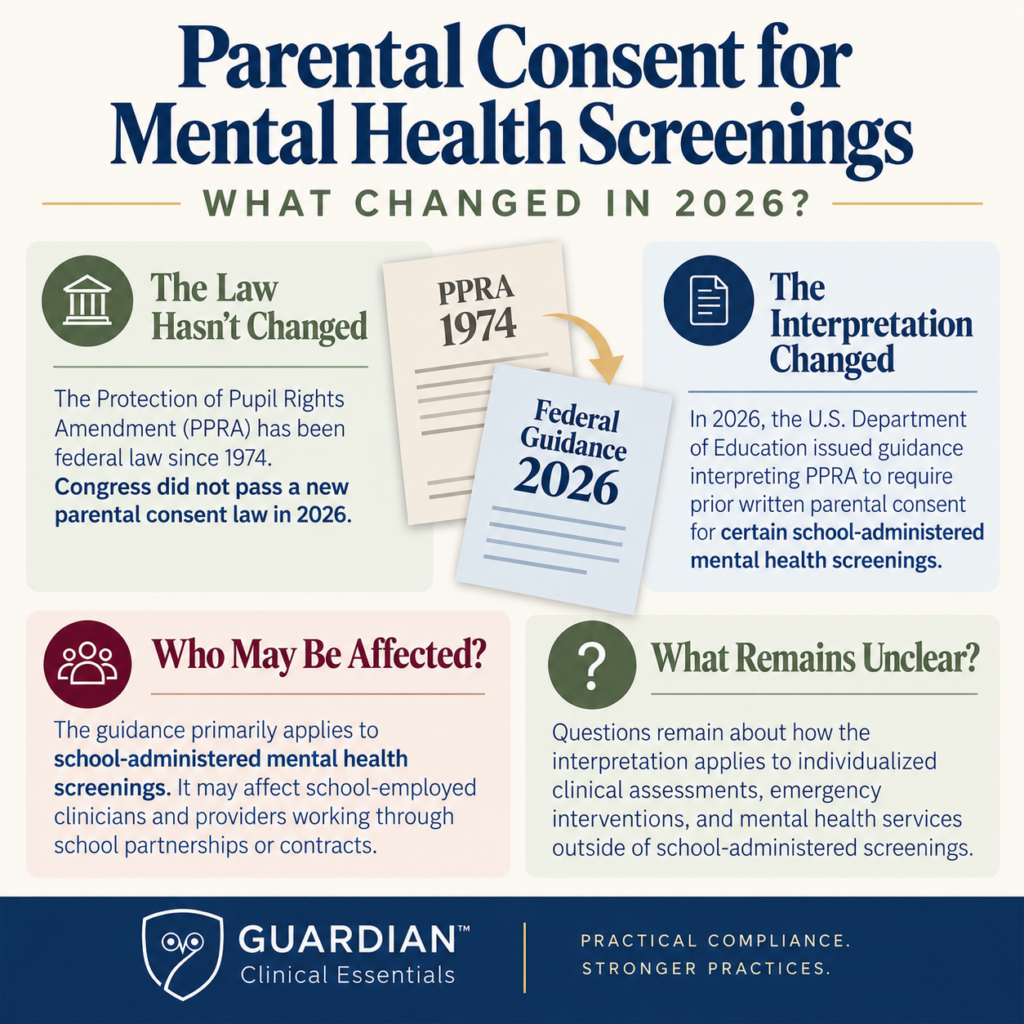
Let’s get one thing straight from the beginning: Congress has not passed a new law or regulation requiring parental consent for school mental health screenings. Instead, federal agencies have issued a new interpretation of a law that has been around since 1974. And that interpretation is creating some pretty significant questions for mental health professionals working with children and adolescents.
In August 2026, the U.S. Department of Education issued guidance addressing parental consent for certain school-administered surveys and mental health screenings. Then, on October 5, the Departments of Education and Justice sent a joint letter to state attorneys general reinforcing that position, including a warning that parental opt-out procedures are not sufficient for screenings covered by their interpretation.
Before everyone gets themselves in a twist and starts rewriting consent forms, we need to understand what changed, who is affected, and what this means for mental health professionals working in different settings. Despite some of the concerns circulating, this is not a new federal law requiring every therapist to obtain parental permission before providing outpatient treatment to a minor.
The Important Distinction
The federal law hasn’t changed. What changed in 2026 is how the U.S. Department of Education interprets parental consent requirements for certain school-administered mental health screenings. This interpretation does not create a blanket parental consent requirement for all mental health treatment involving minors.
What Changed With Federal Parental Consent Requirements?
The law behind this development is the Protection of Pupil Rights Amendment (PPRA), 20 U.S.C. § 1232h, originally enacted on August 21, 1974. Yes, we’re talking about a law that’s been around for more than 50 years! It has been amended several times since then and establishes parental rights concerning certain school-administered surveys, analyses, and evaluations involving sensitive information, including students’ mental or psychological problems.
Under PPRA, prior written parental consent is required before an unemancipated minor is required to participate in a covered survey, analysis, or evaluation as part of an applicable federally administered education program. The statute also establishes separate parental notification, inspection, and opt-out provisions for certain activities. Those distinctions are important because not every survey or evaluation is governed by precisely the same requirement.
The significant development came from the U.S. Department of Education’s Student Privacy Policy Office (SPPO) in its August 26, 2026 guidance. The department explained that when teachers, counselors, or other school officials administer surveys or evaluations involving protected information, students may feel compelled to participate even when the activity is described as voluntary. Consequently, the department announced that it would treat those activities as required for purposes of PPRA’s advance parental consent requirements.
And this is where I have some questions. Having worked with children and adolescents for decades, including in school settings, I know that getting teenagers to participate in something they don’t want to do can be an accomplishment in itself. Sometimes getting them to complete their homework is enough of a challenge! But the federal department’s position is that the authority of school personnel can make an activity feel mandatory, even when students are told they can decline.
The October 5, 2026 joint federal letter reinforced that interpretation, specifically addressing mental health screenings and similar evaluations offered or facilitated by schools. The agencies emphasized that prior written parental consent is necessary under their interpretation and that simply allowing parents to opt out is insufficient.
Congress did not pass a new law in October. Federal agencies issued guidance explaining how they interpret and intend to enforce existing federal law. That position carries practical significance for schools receiving federal education funding, but it does not automatically resolve every question involving individual clinical services or state minor consent laws.
Which Mental Health Professionals Are Affected?
School-employed social workers, counselors, and psychologists are among the professionals most directly affected by this guidance. Schools need to evaluate how they administer mental health questionnaires, psychological screenings, and other assessments that may reveal protected information. Existing procedures that rely on parental notification and an opportunity to opt out may not satisfy the federal agencies’ current interpretation.
Things become more complicated when clinicians work inside schools but are employed by another organization. Michigan’s Section 31n program is a good example. Clinicians may work through intermediate school districts (ISDs) and provide counseling, psychotherapy, screening, and crisis intervention to students. But Michigan is far from the only state with school-based behavioral health programs.
For example, New York operates school-based mental health clinics through partnerships with licensed mental health providers. New Jersey has its NJ4S Statewide Student Support Services program, which connects schools and students with prevention services and mental health support. North Carolina requires school-based mental health plans, including suicide risk referral procedures. Tennessee funds School-Based Behavioral Health Liaisons, and Oklahoma recognizes multiple school-based mental health service models, including district-employed clinicians and partnerships with community providers.
These are just a few examples. Across the country, states have established their own programs and partnerships to connect students with behavioral health services. Some clinicians are employed directly by school districts, while others work through community mental health agencies, contracted providers, or collaborative arrangements with schools. Although the structures and titles vary, these professionals may face similar questions about parental consent, student screenings, and their clinical responsibilities under the federal interpretation.
The clinician’s employer and physical location are relevant, but neither automatically determines whether a particular activity is covered by PPRA. We also need to consider who administers or facilitates the service, the relationship with the educational agency, and whether the activity falls within the federal requirements. An ISD-employed therapist conducting an individual clinical assessment should not automatically be treated as identical to a classroom teacher administering a schoolwide screening, but neither should we assume the clinician is exempt simply because the service is called therapy.
State minor consent laws add another layer. For example, Michigan’s MCL 330.1707 permits qualifying minors age 14 and older to request and receive certain outpatient mental health services without parental consent, subject to statutory limitations. That authority remains in place. However, a minor’s ability to consent to outpatient treatment does not necessarily answer whether a particular screening administered through a school is subject to PPRA.
What about outpatient therapists and community mental health providers? For independent outpatient services, the federal letters do not establish a new blanket requirement for parental consent. Therapists should continue following applicable state minor consent laws, confidentiality requirements, and professional standards. When an outpatient provider delivers services through a school contract or partnership, however, the arrangement warrants closer examination.
What Happens When a Student Is Suicidal?
This is where my clinical concerns immediately kicked in when I first heard about the guidance. I wasn’t particularly worried about schools reviewing consent procedures for routine mental health questionnaires. I was concerned about what happens when a student walks into a social worker’s office and discloses suicidal thoughts.
Are we seriously suggesting that a licensed clinician cannot ask questions to determine whether a student is in immediate danger because there isn’t a signed parental consent form on file?
The federal letters do not expressly establish a blanket prohibition against responding to a student experiencing a mental health crisis. However, the October letter uses broad language concerning screenings and evaluations, and neither letter clearly explains how its interpretation applies to every individualized suicide risk assessment or emergency intervention.
There is an important clinical distinction between administering routine mental health screenings, conducting an individualized assessment, and responding to an immediate safety concern. Those activities may involve similar questions, but they do not necessarily serve the same purpose or operate under identical legal requirements. We cannot assume every assessment instrument is exempt simply because a clinician administers it, and we should not assume the federal guidance prohibits all emergency clinical responses.
But there’s another concern here that I don’t think we should overlook: What happens to the students whose mental health needs might have been identified through screening, but whose parents never return the consent form?
After decades of working with children and adolescents, and as a parent myself, I know that parents don’t always know everything their teenagers are experiencing. Sometimes kids are more willing to share what they’re feeling with someone outside their family, and a school screening may be one of the opportunities to identify a student who needs additional support.
According to the CDC’s 2025 Youth Risk Behavior Survey findings, approximately 14% of U.S. high school students seriously considered attempting suicide, 6% reported attempting suicide, and 33% experienced persistent feelings of sadness or hopelessness during the previous year. Those numbers improved from approximately 20%, 9%, and 40%, respectively, in 2023. That’s encouraging progress, but it also means a substantial number of students continue to struggle. These figures reflect students’ self-reported experiences, not suicide death rates.
Requiring written parental consent before certain school screenings adds another step between students and an opportunity for early identification. That doesn’t mean every parent would object, or that screening alone guarantees a student will receive help. But how many students might miss that opportunity simply because a form wasn’t returned? And what happens when schools depend on screening data to identify needs, support programs, and demonstrate the demand for mental health resources? Those are questions worth asking, especially when we’re trying to improve access to services, not make it more difficult.
This is precisely why schools, ISDs, and other organizations employing licensed mental health professionals need written procedures that address these situations. Clinicians should know what they are expected to do when a student spontaneously discloses suicidal ideation, how immediate safety concerns are evaluated, when parents must be contacted, and what happens when parental consent cannot be obtained.
There is also the matter of individual professional responsibility. School district and ISD attorneys generally represent their organizations, not the personal licensing interests of every clinician employed there. Following an employer’s policy does not automatically eliminate a licensed professional’s obligations or potential licensing exposure. That doesn’t mean clinicians should disregard legal advice or organizational policies. It means clinical leadership and legal counsel need to address those responsibilities together before a crisis occurs.
California Has a Different Interpretation
And just when you thought we might have some clarity, California decided to throw its own interpretation into the mix. Because apparently one federal law and two federal agencies weren’t enough to make things complicated.
In its September 23, 2026 explanation of PPRA and FERPA, the California Department of Education emphasized that the federal guidance does not change the underlying statute or independently create new legal requirements. California disputes the federal department’s interpretation that every school-administered survey involving protected information must be treated as required, regardless of whether participation is voluntary.
California also identifies circumstances under its own education laws in which certain anonymous, voluntary, and confidential student health surveys may use a parental opt-out process. That is not a blanket exemption for every mental health screening.
The disagreement does not exempt California schools from federal law or settle how the statute will ultimately be interpreted. It does demonstrate that the federal agencies’ position is contested, making it particularly important for schools and clinicians to distinguish the law itself from agency interpretations and enforcement positions.
Who has time to track every new AI, HIPAA, and privacy law? Apparently, I do. And I love it!
Sign up for the Guardian Clinical Essentials newsletter and get important compliance updates for behavioral health practices delivered straight to your inbox. No fluff, just the developments worth knowing about.
What Should Therapists Do Now?
The most important thing to understand is that the federal law itself has not changed. What changed is how the U.S. Department of Education is interpreting that law, with the Department of Justice reinforcing that interpretation. And as California has demonstrated, not everyone agrees on what the existing law requires.
For independent outpatient therapists, these federal letters do not create a new blanket parental consent requirement. Continue following the laws that apply to your state, license, and practice setting. For school-employed clinicians, ISD providers, and therapists working through school partnerships, the answer is more complicated because the organization responsible for administering the services may adopt policies based on the federal interpretation.
That makes it important to understand who oversees your work, which requirements apply to your particular role, and how your school district, ISD, or employing agency expects you to handle screenings, treatment requests, and immediate safety concerns. If those expectations are unclear, ask for clarification in writing rather than trying to figure it out when a student needs help.
And if you believe an organizational policy conflicts with your professional ethics, clinical judgment, or licensing responsibilities, don’t assume that following the policy automatically protects your license. But don’t simply disregard it, either. Understand the applicable requirements, seek appropriate legal or professional guidance, and make informed decisions about how to fulfill your responsibilities.
Parental rights, student confidentiality, access to mental health treatment, and clinical responsibilities all deserve consideration. We can respect the importance of parental involvement while also recognizing that additional consent requirements may create barriers for students who need support.
Because when a student comes to us in crisis, nobody should be trying to figure out the organization’s interpretation of a 52-year-old federal law for the first time.
Frequently Asked Questions
Did the federal government pass a new law requiring parental consent for school mental health screenings in 2026?
No. Congress did not pass a new parental consent law in 2026. The U.S. Department of Education issued new guidance interpreting the existing Protection of Pupil Rights Amendment (PPRA), originally enacted in 1974. The Department of Justice reinforced that interpretation in October 2026. The federal agencies now take the position that certain school-administered mental health screenings require prior written parental consent, even when participation is described as voluntary.
Do school social workers and counselors need parental consent before conducting mental health screenings?
Certain school-administered mental health screenings may require prior written parental consent under the federal government’s 2026 interpretation of PPRA. Whether that requirement applies depends on the screening, who administers it, and the school’s involvement. School social workers, counselors, and psychologists should review their district’s procedures and seek clarification about individualized clinical assessments, routine screenings, and emergency interventions. These activities should not automatically be treated as legally identical.
Does the new federal guidance affect therapists working through school contracts or community mental health agencies?
Potentially, yes. Therapists employed by community mental health agencies, intermediate school districts, or contracted providers may be affected when they administer or facilitate screenings through schools. Their employment arrangement alone does not determine whether PPRA applies. The nature of the activity, the school’s involvement, and the applicable federal and state requirements all matter. Organizations should clarify these responsibilities in their contracts, consent procedures, and clinical policies.
Can a school social worker assess a suicidal student without written parental consent?
The 2026 federal guidance does not expressly prohibit clinicians from responding to students experiencing a mental health crisis. However, the federal letters do not clearly explain how their interpretation applies to every individualized suicide risk assessment or emergency intervention. Clinicians should distinguish routine screening activities from immediate clinical safety responses and follow applicable laws and professional obligations. Schools and employing agencies should establish written crisis procedures that address these situations before an emergency occurs.
Does the 2026 parental consent guidance change the rules for outpatient therapists treating minors?
No. The federal guidance does not create a blanket parental consent requirement for independent outpatient mental health treatment. Therapists must continue following applicable state laws governing minors’ consent, confidentiality, and treatment. For example, Michigan law permits qualifying minors age 14 and older to consent to certain outpatient mental health services under specified conditions. Additional questions may arise when outpatient therapists provide services through school-based programs or contractual partnerships.
Can schools still use parental opt-out forms for mental health screenings?
A parental opt-out process may not satisfy the federal agencies’ 2026 interpretation for screenings subject to PPRA’s prior written consent requirement. The Department of Education and Department of Justice have taken the position that certain school-administered activities require affirmative parental permission. California has publicly disputed aspects of that interpretation and identifies circumstances where opt-out procedures remain appropriate. Schools should evaluate the specific activity, applicable law, and current legal guidance rather than assuming one consent process applies to every screening.
Guardian Clinical Essentials™ provides behavioral health practices with customized compliance documentation, HIPAA resources, and consulting services addressing privacy, security, vendor management, and emerging technology requirements.
This article is provided for educational and informational purposes and does not constitute legal advice. Clinicians and organizations should evaluate the federal and state laws, licensing requirements, professional standards, and organizational policies applicable to their specific roles and services.
Related Articles & Resources for Therapists
This article is part of the Guardian Clinical Essentials™ HIPAA & Practice Compliance Article Hub, created to help therapists and behavioral health practices understand how privacy, security, and compliance requirements apply to running a successful and safe therapy practice.
You may also want to read these related topics:
- HIPAA Risk Assessments for Therapists: What Mental Health Providers Are Actually Required to Do
- HIPAA Documentation Requirements for Therapists: What Documentation Does a Practice Actually Need?
- What to Do If You Think You Violated HIPAA (Step-by-Step for Therapists)
- Do You Need Client Consent to Use AI?
- What Should an AI Policy Include for a Therapy Practice?
About the Author
Samantha Schalk, LMSW-C, LMSW-M, CAADC, CIMHP, BCP3, CHPSE
Samantha is a licensed mental health professional, private and group practice owner, Certified HIPAA Privacy Security Expert (CHPSE), and the founder of Guardian Clinical Essentials™.
Her work focuses on helping therapists and behavioral health practices understand and implement requirements involving HIPAA, privacy, security, documentation, technology, and practice operations.
Drawing from her experience in clinical practice, supervision, practice ownership, and compliance consulting, Samantha develops practical compliance resources, training, and implementation guidance specifically for behavioral health professionals.
Learn more about Samantha and Guardian Clinical Essentials™.

Continue Exploring Guardian Clinical Essentials™
Looking for additional compliance, privacy, AI, documentation, and practice operations resources?
Explore the Guardian Clinical Essentials™ Resource Library for educational articles, implementation guidance, training opportunities, and practical resources designed specifically for mental health professionals.