
Do You Need Client Consent to Use AI?
Whether you need client consent depends on how AI is being used within your practice.
Using AI to help write a blog post is different from using AI to assist with documentation. Using AI to organize administrative work is different from using AI in a workflow that involves client information. Those differences matter because they affect both the role AI plays in your practice and the conversations you may need to have with clients.
That is why there is no single answer that applies to every situation. Instead of asking whether AI always requires client consent, it is more helpful to look at how the technology is being used, whether client information is involved, and what clients would reasonably expect to know about its role in their care.
Does Every Use of AI Require Client Consent?
No. Every use of AI does not automatically require client consent because not every use of AI has the same relationship to client care.
A therapist using AI to draft a newsletter, organize a schedule, or help write website content is making a very different decision than a therapist using AI to assist with documentation, treatment planning, or other workflows connected to clinical services. Treating every use of AI as though it carries the same considerations makes the conversation more confusing than it needs to be.
A more practical approach is to look at what the AI is actually doing. Is it simply supporting business operations, or is it being used in a way that could affect client care, client information, or the therapeutic process? Those distinctions often provide more meaningful guidance than trying to apply one answer to every AI tool or every workflow.
Once the conversation shifts from “Does AI require client consent?” to “How is AI being used in this situation?” the next steps usually become much clearer.
When AI Use Involves Client Information, Do You Need Client Consent?
Once client information becomes part of the conversation, the decision is no longer just about whether AI is being used. It also becomes a question of how client information is being handled and whether clients should understand the role AI plays in that process.
That does not automatically mean client consent is required. It does mean therapists should think carefully about whether the way AI is being used changes what clients would reasonably expect to know about their care. In some situations, discussing AI use with clients may support transparency and help strengthen informed decision-making, even when a separate consent process may not be legally required.
This is also where it becomes important to separate client consent from HIPAA compliance. They are related concepts, but they are not interchangeable. The U.S. Department of Health and Human Services’ guidance on Business Associates under HIPAA explains when organizations that create, receive, maintain, or transmit protected health information may have responsibilities under HIPAA. Understanding those obligations is one part of evaluating an AI workflow. Deciding what clients should know about that workflow is a separate decision.
For many therapists, the question ultimately comes back to transparency. If AI plays a meaningful role in how client information is used within a workflow, it is reasonable to consider whether clients should understand that role before deciding to participate in treatment.
Do You Need Client Consent If Information Has Been De-Identified?
It may, but not always.
Removing identifying information changes an important part of the conversation because information that has been properly de-identified is treated differently than identifiable protected health information. The U.S. Department of Health and Human Services’ guidance on de-identification explains the methods that can be used to remove identifying information under HIPAA.
That does not mean every question about client consent disappears. Therapists still need to consider how the AI is being used, whether the information has truly been de-identified, and whether clients would reasonably expect to know that AI is part of the workflow. Those are separate considerations from whether identifying information has been removed.
In many situations, de-identification changes one piece of the analysis, but it does not automatically answer the broader question of whether discussing AI use with clients is appropriate.
Are Some AI Uses More Likely to Raise Consent Questions Than Others?
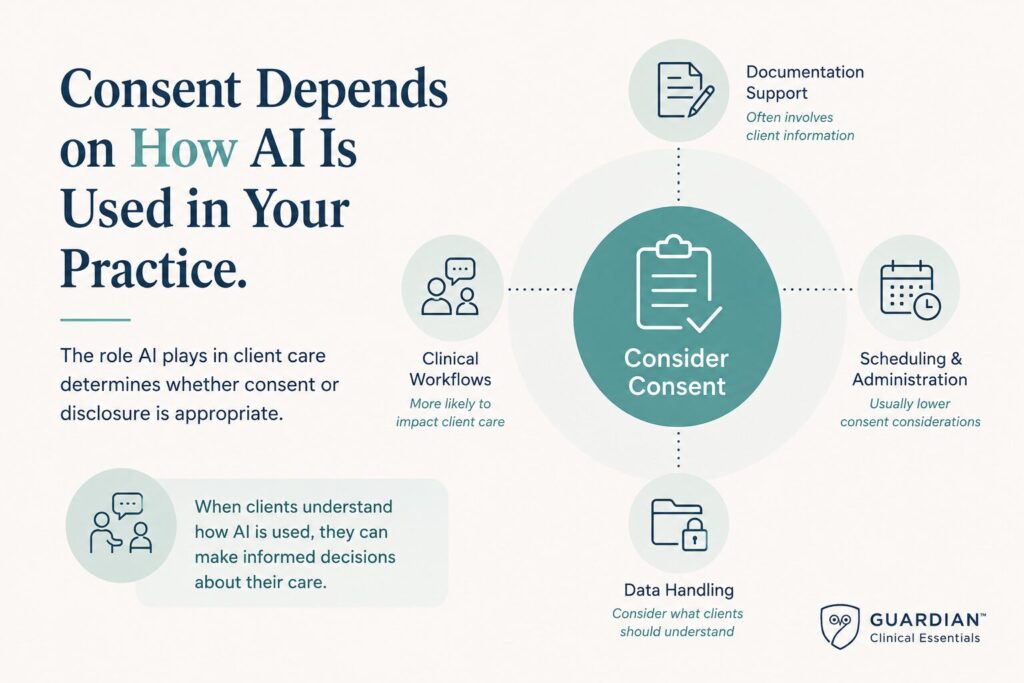
Yes. The closer AI gets to the delivery of clinical services, the more likely therapists are to ask whether clients should know it is being used.
Most clients are unlikely to have concerns about AI helping draft website content, organize a calendar, or support other routine business operations. Those uses generally happen behind the scenes and have little effect on the client’s experience. AI used for documentation, treatment planning, session summaries, or other activities connected to clinical care can feel very different because it plays a more direct role in the services clients receive.
Looking at AI as a single category can make the conversation more confusing than it needs to be. Different AI tools serve different purposes, and those differences matter when deciding whether client consent or disclosure is appropriate. Rather than asking whether AI requires consent, it is often more helpful to evaluate the specific workflow and the role the technology plays within it.
Understanding that distinction can also help practices develop more consistent expectations. Two AI tools may both use artificial intelligence, but that does not automatically mean they should be treated the same when deciding how to communicate their use to clients.
Before You Decide
Client consent isn’t based on whether a tool uses AI. It’s based on how AI is being used within your practice. The more closely AI is connected to client care or client information, the more important it becomes to consider whether clients should be informed or whether consent is appropriate. Looking at the workflow rather than the technology itself often leads to clearer and more consistent decisions.
Should AI Be Addressed in Informed Consent Documents?
It might, depending on how AI is being used within your practice.
If AI plays a meaningful role in documentation, clinical workflows, or the way services are delivered, many therapists may decide it belongs in their informed consent documents. Including it there creates an opportunity to explain the practice’s approach before questions arise, rather than trying to introduce the topic after services have already begun.
The APA Ethical Principles of Psychologists and Code of Conduct emphasizes informed decision-making and helping clients understand information that may affect their care. While the Ethics Code does not prescribe specific language about AI, it reinforces the broader principle that clients should have enough information to make informed decisions about treatment.
That does not mean informed consent documents need several pages explaining artificial intelligence. In many cases, a brief explanation written in plain language is far more useful than a lengthy technical description. The goal is to help clients understand whether AI is being used, how it fits into the services you provide, and whether it changes anything they should know before agreeing to treatment.
What Details Should Be Included When Obtaining Client Consent?
If you decide client consent is appropriate, the goal is not to explain everything about artificial intelligence. The goal is to give clients enough information to understand how AI is being used and whether that information affects their decision to receive services.
What that discussion includes will depend on the role AI plays in your practice. Clients may benefit from understanding whether AI is involved in documentation, how their information is being handled, whether the therapist reviews and approves any AI-generated work, and whether AI changes any aspect of the care they receive. The conversation should reflect your actual workflow rather than a generic description of AI.
Like every part of informed consent, the information should be clear, accurate, and easy to understand. Clients should not have to sort through technical language or software terminology to understand what they are agreeing to. A straightforward explanation that reflects your practice is usually more valuable than a lengthy disclosure filled with details that are unlikely to influence a client’s decision.
If your use of AI changes over time, your informed consent process should be updated to reflect those changes. Keeping consent documents aligned with your actual workflow helps ensure that the information clients receive remains accurate and meaningful.
What If the AI Tool Does Not Provide a Client Consent Form?
Many AI vendors do not provide client-facing consent forms, and that is not necessarily a problem. Software companies can explain how their products work, but they cannot determine what information your clients should receive or how consent should be handled within your practice.
If you decide client consent is appropriate, the responsibility for obtaining that consent generally rests with the therapist or the practice, not the AI vendor. That is because informed consent is based on your services, your workflow, and the way you use the technology. Two therapists could use the same AI platform in very different ways, which means their conversations with clients may look different as well.
Rather than looking for a vendor-provided consent form, it is often more helpful to decide what your clients need to understand about your use of AI. That information can then be incorporated into your existing informed consent process, practice policies, or other client-facing documents in a way that reflects how your practice actually operates.
What Should Therapists Tell Clients About AI Use?
The answer depends on how AI is being used within your practice, but the goal is usually the same: help clients understand anything that could reasonably affect their decision to receive services.
That does not require a technical explanation of artificial intelligence or a detailed description of every software platform you use. Most clients are not trying to understand how AI works. They are trying to understand how it affects them.
If AI plays a role in documentation, communication, or another part of the care they receive, clients should be able to understand that role in clear, straightforward language. They should know what AI is being used for, whether it affects their information, and what role you continue to play in reviewing, making clinical decisions, and providing treatment.
The conversation should leave clients with a better understanding of your practice, not more questions about the technology. When AI is explained in practical terms rather than technical ones, clients are better able to make informed decisions and understand what to expect throughout the therapeutic process.
Do You Need to Inform Clients About Using AI for Scheduling, Administrative, and Other Practice Tools?
Not necessarily.
Many therapy practices already rely on technology to manage scheduling, appointment reminders, billing, intake paperwork, and other administrative tasks. AI is becoming part of many of those systems, but that does not automatically mean every administrative use requires a separate discussion with clients.
The better question is whether the AI plays a meaningful role in the client’s experience or involves information that clients would reasonably expect to know about. If AI is simply helping your practice operate more efficiently behind the scenes, the need for specific disclosure may be different than if AI is involved in documentation, clinical decision support, or other aspects of service delivery.
Rather than trying to create one rule for every AI tool, evaluate how the technology is being used and whether that use changes what a reasonable client would want to know before or during treatment. That approach is often more practical than focusing on whether a particular piece of software happens to include AI.
Stay Updated on Compliance Changes
Compliance expectations are constantly evolving, and most providers don’t hear about changes until they become a problem.
If you want clear, practical updates you can actually use, you can join my email list below.
The Bottom Line
Client consent and AI are rarely answered with a simple yes or no because AI is not a single activity. The answer depends on how the technology is being used, the role it plays in your practice, and whether that use changes what clients should understand before deciding to engage in services.
For some practices, AI may be something that belongs in informed consent documents or becomes part of conversations with clients. For others, the technology may be limited to administrative tasks that have little impact on the client’s experience. The important point is not to assume every AI tool should be treated the same.
As AI becomes more common in therapy practices, therapists will continue making decisions about when consent, disclosure, or transparency are appropriate. Those decisions are often easier to make when they are based on the actual workflow rather than the technology itself. Understanding how AI is being used, what role it plays in client care, and what clients would reasonably want to know provides a much stronger framework than trying to apply one answer to every situation.
FAQs
Can I Include AI Consent in My Existing Informed Consent Form?
Yes, many therapists can address AI within their existing informed consent documents rather than creating a separate consent form.
If AI plays a meaningful role in your practice, adding a clear explanation to your informed consent paperwork may be more practical than asking clients to sign an additional document. The language should reflect how AI is actually being used in your practice so clients understand what to expect before services begin.
Does Every AI Tool Require a Separate Client Consent Form?
No, not every AI tool requires a separate client consent form.
AI can be used in many different ways within a therapy practice, and those differences matter. A therapist using AI for administrative tasks may reach a different conclusion than one using AI within clinical workflows. The decision should be based on the role the technology plays in your practice rather than the presence of AI alone.
Can Clients Decline AI Use and Still Receive Therapy?
Sometimes they can, depending on how AI is used within the practice.
If AI is optional within a particular workflow, a therapist may be able to offer an alternative approach. In other situations, AI may already be integrated into practice operations or documentation systems in ways that are not easily separated. Therapists should consider how those decisions affect client expectations and communicate their approach clearly.
Should Existing Clients Be Told If My Practice Starts Using AI?
Yes, it is generally appropriate to inform existing clients when AI changes a meaningful part of your practice or the services you provide.
Clients should understand information that could influence their decisions about treatment or their expectations for care. Communicating those changes early helps maintain transparency and gives clients an opportunity to ask questions.
Should Group Practices Use the Same AI Consent Process for Every Clinician?
Yes, group practices should strive for a consistent approach to AI consent and disclosure.
Individual clinicians may use different workflows or technologies, but clients should receive clear and consistent information about how AI is used within the practice. Establishing practice-wide expectations also helps reduce confusion and supports a more consistent client experience.
If I Stop Using AI, Should I Update My Informed Consent Documents?
Yes, informed consent documents should reflect your current practice rather than outdated workflows.
If AI is removed from your documentation process or other services, updating client-facing materials helps ensure the information remains accurate. Reviewing informed consent whenever technology workflows change is a practical way to keep documentation aligned with how your practice actually operates.
Related Articles in This AI + HIPAA Series
Therapists exploring AI documentation often have additional questions that extend beyond progress notes alone.
Related topics include:
- AI + HIPAA: Resources Hub & Next Steps
- Is AI HIPAA Compliant for Therapists?
- Can Therapists Use ChatGPT for Progress Notes?
- Does a Business Associate Agreement Make AI HIPAA Compliant?
- What AI Risks Belong in a HIPAA Security Risk Analysis?
- Can Therapists Paste Client Information Into AI Tools?
- What Should an AI Policy Include for a Therapy Practice?
- Can Group Practices Allow Staff to Use AI Documentation Tools?
- Are AI Therapy Note Tools Safer Than Recording Sessions?
- What Happens to Client Information After AI Processes It?
- Building AI for Therapy Practices: Behind the Scenes with Uriah Guilford
- Colorado’s New AI Law for Therapists: What Mental Health Practices Need to Change Now
Other Compliance Articles Coming Soon…
- Can Therapists Use AI for Treatment Plans?
- How Should Therapists Document AI Use in Practice?
About the Author
Samantha Schalk, LMSW-C, LMSW-M, CAADC, CIMHP, BCP3
Samantha is a licensed mental health professional, private and group practice owner, and the founder of Guardian Clinical Essentials™.
She helps therapists and group practices understand how compliance, documentation, privacy, technology, and practice operations work together in real-world clinical settings. Her work focuses on turning complex requirements into practical systems, policies, workflows, and implementation strategies that providers can actually use.
Drawing from experience in both clinical practice and compliance consulting, Samantha specializes in helping mental health professionals build defensible, sustainable systems that support both quality care and regulatory compliance.
Learn more about Samantha and Guardian Clinical Essentials™.

Continue Exploring Guardian Clinical Essentials™
Looking for additional compliance, privacy, AI, documentation, and practice operations resources?
Explore the Guardian Clinical Essentials™ Resource Library for educational articles, implementation guidance, training opportunities, and practical resources designed specifically for mental health professionals.