
Are AI Therapy Note Tools Safer Than Recording Sessions?
The short answer is that recording a session is not automatically riskier than using an AI therapy note tool.
At the same time, using an AI therapy note tool is not automatically safer than recording a session.
Part of the challenge is that therapists often talk about AI documentation tools as though they all work the same way. They do not. Some AI tools rely on recordings. Some generate transcripts. Some process information in real time. Some store information for longer periods than others.
That means two therapists may both say they are using an AI documentation tool while using completely different workflows behind the scenes.
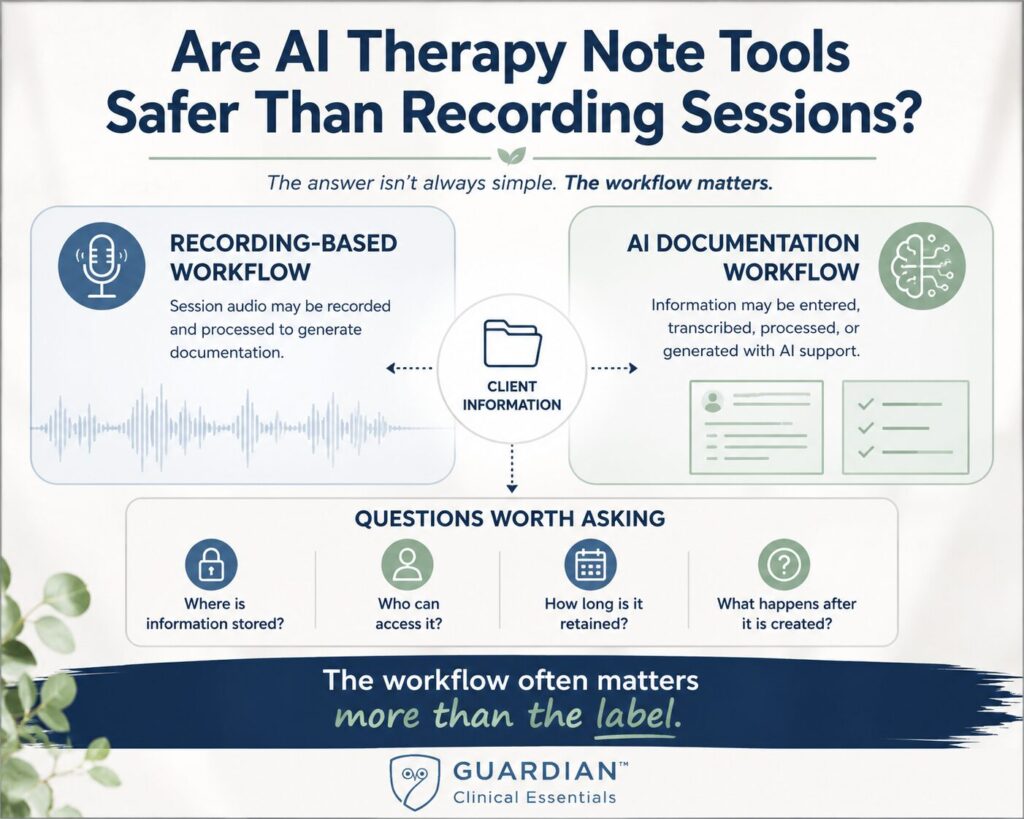
When I hear therapists discussing whether AI or recordings are safer, what they are often trying to understand is where risk actually exists. The answer is usually found in the workflow itself. How is information collected? Where is it stored? Who has access to it? How long is it retained? What safeguards are in place to protect it?
Evaluating those questions is consistent with the broader approach outlined in the HHS guidance on Security Risk Analysis and Risk Management.
In many cases, therapists are not really comparing recordings versus AI. They are comparing one documentation workflow to another.
Do All AI Therapy Note Tools Record Sessions?
No, and I think this is one of the reasons these conversations can become confusing.
The phrase “AI therapy note tool” is often used as though it describes a single type of technology. In reality, there are significant differences between products.
Some tools rely on recordings as part of the documentation process. Others create transcripts. Some use live audio processing. Others work from information that a therapist manually enters after the session. The way information moves through the system can look very different depending on the product being used.
This matters because therapists sometimes assume they are comparing recordings to AI when they may actually be looking at a workflow that includes both.
A tool may create a recording, generate a transcript from that recording, use artificial intelligence to organize the information, and then produce a clinical note. Another tool may only assist with documentation after the therapist enters information manually.
Those are very different processes, even though both may be marketed as AI documentation tools.
Understanding how a particular tool functions is often more useful than focusing on whether the product is labeled as AI.
Why Are Therapists Concerned About Recordings?
I think there are a few different reasons recordings tend to create strong reactions.
For some therapists, recordings simply feel more intrusive. Even if they understand the purpose of the technology, the idea of creating an audio file of a therapy session feels fundamentally different than typing notes after the session is over.
For others, the concern is not the recording itself. It is what happens afterward.
Over the past year, I have seen more therapists paying attention to conversations about recordings, transcripts, retained data, and situations where information was later accessed during legal proceedings. Stories involving therapy platforms and stored communications have led many clinicians to ask questions they may not have considered previously.
How long is information retained?
Who has access to it?
Can a recording or transcript continue to exist long after the therapist believes it has been deleted?
Could information be produced later in a way that affects the client?
Those concerns are understandable. They reflect a growing awareness that documentation decisions are not only about creating information. They are also about understanding what happens to that information after it exists.
What I find interesting is that these concerns often apply to more than recordings. Therapists are increasingly asking similar questions about transcripts, AI-generated content, platform storage practices, and other forms of retained information.
The concern is often less about the format and more about retention, access, and control.
What Happens After Information Is Created?
Many conversations about AI documentation tools focus on how notes are created.
Increasingly, therapists are also paying attention to what happens afterward.
A recording may be stored.
A transcript may be retained.
An AI-generated note may exist inside multiple systems.
Understanding where information goes, who can access it, how long it is retained, and what happens after the documentation process is complete can provide valuable insight into how a documentation workflow actually functions.
Sometimes the most important questions are not about how information is created. They are about what happens once it exists.
What Should Therapists Evaluate Before Choosing a Documentation Workflow?
One thing I encourage therapists to do is spend less time focusing on the marketing language surrounding a product and more time understanding how the workflow actually functions.
A product may advertise artificial intelligence, automation, efficiency, or documentation support. Those descriptions do not necessarily tell you how information moves through the system.
Questions worth exploring often include:
• Is a recording being created?
• Is a transcript being created?
• Where is information stored?
• Who can access it?
• How long is it retained?
• What happens after the documentation process is complete?
Understanding those answers can provide a much clearer picture of the workflow than simply determining whether a product uses AI.
The NIST Artificial Intelligence Risk Management Framework emphasizes understanding how technology functions within larger systems and organizational processes rather than evaluating tools in isolation.
The goal is not to determine whether recordings are universally safe or whether AI is universally risky.
The goal is to understand how a particular documentation workflow handles client information and whether that approach aligns with your clinical, ethical, operational, and privacy considerations.
Stay Updated on Compliance Changes
Compliance expectations are constantly evolving, and most providers don’t hear about changes until they become a problem.
If you want clear, practical updates you can actually use, you can join my email list below.
Final Thoughts
One of the things I find most interesting about these conversations is that therapists with very different comfort levels often end up asking the same question.
They want to know which approach creates less risk.
The answer is rarely found in the label attached to the technology.
Recording a session is not automatically riskier than using an AI therapy note tool. Likewise, using an AI therapy note tool is not automatically safer than creating a recording.
The more useful evaluation often comes from understanding how information is collected, processed, stored, retained, and protected throughout the workflow.
When therapists understand what is happening behind the technology, they are in a much stronger position to make informed decisions about the documentation tools they choose to use.
FAQs
Are AI therapy note tools always recording sessions?
No, not all AI therapy note tools record sessions.
AI documentation tools can function in very different ways. Some rely on recordings as part of the documentation process, while others use transcripts, live processing, or therapist-entered information. Two tools may both be marketed as AI documentation solutions while handling client information very differently behind the scenes. Understanding how a specific tool functions is often more useful than relying on the AI label alone.
Are session recordings automatically a HIPAA violation?
No, session recordings are not automatically a HIPAA violation.
The existence of a recording is only one part of the conversation. Therapists also need to understand how the recording is collected, stored, protected, accessed, and retained within the documentation workflow. Evaluating those factors often provides a clearer picture of risk than focusing solely on whether a recording exists.
Why are therapists concerned about recording-based documentation tools?
Many therapists have questions about retention, storage, and access.
For some clinicians, recordings simply feel outside their comfort zone because they create a different experience than traditional note-taking. Others are more concerned about what happens after the recording is created, including where it is stored, how long it is retained, and who may be able to access it in the future. Recent conversations within the profession have also increased awareness around these questions.
Can recordings and transcripts be retained longer than therapists expect?
Sometimes they can.
Retention practices vary by platform, vendor, and workflow. In some situations, therapists may assume information is temporary without fully understanding how long it is stored or what happens to it after the documentation process is complete. Reviewing privacy policies, terms of service, and platform documentation can help clarify how information is managed over time.
Is an AI-generated therapy note safer than a session recording?
Not necessarily.
Different documentation workflows create different considerations. Some AI tools rely on recordings or transcripts, while others do not. The level of risk often depends on how information is collected, processed, stored, retained, and protected rather than whether a product is labeled as AI.
What questions should therapists ask before using an AI documentation tool?
Therapists should understand how information moves through the workflow.
Questions about recordings, transcripts, storage, access, retention, and data handling can provide valuable insight into how a documentation system actually functions. Therapists may also benefit from understanding which vendors are involved, what information is retained, and what happens after documentation is generated. Those answers often reveal more than a product’s marketing materials.
Should therapists review privacy policies and terms of service before using AI documentation tools?
Yes, reviewing these documents can provide important information about how client data is handled.
Many therapists focus on a platform’s features while spending less time reviewing the policies that govern how information is collected, stored, retained, or used. Privacy policies and terms of service can help therapists better understand the workflow they are considering and identify questions they may want answered before adoption.
Does using AI for note assistance create the same considerations as recording sessions?
Not always.
Some therapists use AI to help organize, refine, or strengthen documentation they have already created. Other tools rely on recordings or transcripts as part of the documentation process. Because those workflows differ, the questions therapists should ask about storage, retention, access, and information handling may differ as well.
Related Articles in This AI + HIPAA Series
Therapists exploring AI documentation often have additional questions that extend beyond progress notes alone.
Related topics include:
- AI + HIPAA: Resources Hub & Next Steps
- Is AI HIPAA Compliant for Therapists?
- Can Therapists Use ChatGPT for Progress Notes?
- Does a Business Associate Agreement Make AI HIPAA Compliant?
- What AI Risks Belong in a HIPAA Security Risk Analysis?
- Can Therapists Paste Client Information Into AI Tools?
- What Should an AI Policy Include for a Therapy Practice?
- Can Group Practices Allow Staff to Use AI Documentation Tools?
- What Happens to Client Information After AI Processes It?
- Do You Need Client Consent to Use AI?
- Building AI for Therapy Practices: Behind the Scenes with Uriah Guilford
- Colorado’s New AI Law for Therapists: What Mental Health Practices Need to Change Now
Other Compliance Articles Coming Soon…
- Can Therapists Use AI for Treatment Plans?
- How Should Therapists Document AI Use in Practice?
Sources
Office of the National Coordinator for Health Information Technology’s Work on Artificial Intelligence and Health IT
https://www.healthit.gov/topic/health-it-and-health-information-exchange-basics/artificial-intelligence-health-it
National Institute of Standards and Technology (NIST) Artificial Intelligence Risk Management Framework
https://www.nist.gov/itl/ai-risk-management-framework
American Psychological Association’s Artificial Intelligence Resources and Professional Practice Guidance
https://www.apa.org/topics/artificial-intelligence
About the Author
Samantha Schalk, LMSW-C, LMSW-M, CAADC, CIMHP, BCP3
Samantha is a licensed mental health professional, private and group practice owner, and the founder of Guardian Clinical Essentials™.
She helps therapists and group practices understand how compliance, documentation, privacy, technology, and practice operations work together in real-world clinical settings. Her work focuses on turning complex requirements into practical systems, policies, workflows, and implementation strategies that providers can actually use.
Drawing from experience in both clinical practice and compliance consulting, Samantha specializes in helping mental health professionals build defensible, sustainable systems that support both quality care and regulatory compliance.
Learn more about Samantha and Guardian Clinical Essentials™.

Continue Exploring Guardian Clinical Essentials™
Looking for additional compliance, privacy, AI, documentation, and practice operations resources?
Explore the Guardian Clinical Essentials™ Resource Library for educational articles, implementation guidance, training opportunities, and practical resources designed specifically for mental health professionals.