
What Happens to Client Information After AI Processes It?
One of the questions that comes up pretty quickly when therapists start looking at AI tools is what actually happens to the information after it enters the system. Most of the attention initially goes toward the front end of the process. Can the information be entered into the tool? Is there a Business Associate Agreement? Can AI be used for documentation? Once those questions are answered, people usually start looking further down the workflow and asking what happened to the information after the AI finished processing it.
That question is often more difficult to answer because much of the activity happens behind the scenes. A therapist sees a note, summary, transcript, or recommendation appear on the screen, but there may be several additional steps occurring between the moment information is submitted and the moment a result is returned. Understanding that process is an important part of evaluating any AI tool that may interact with client information.
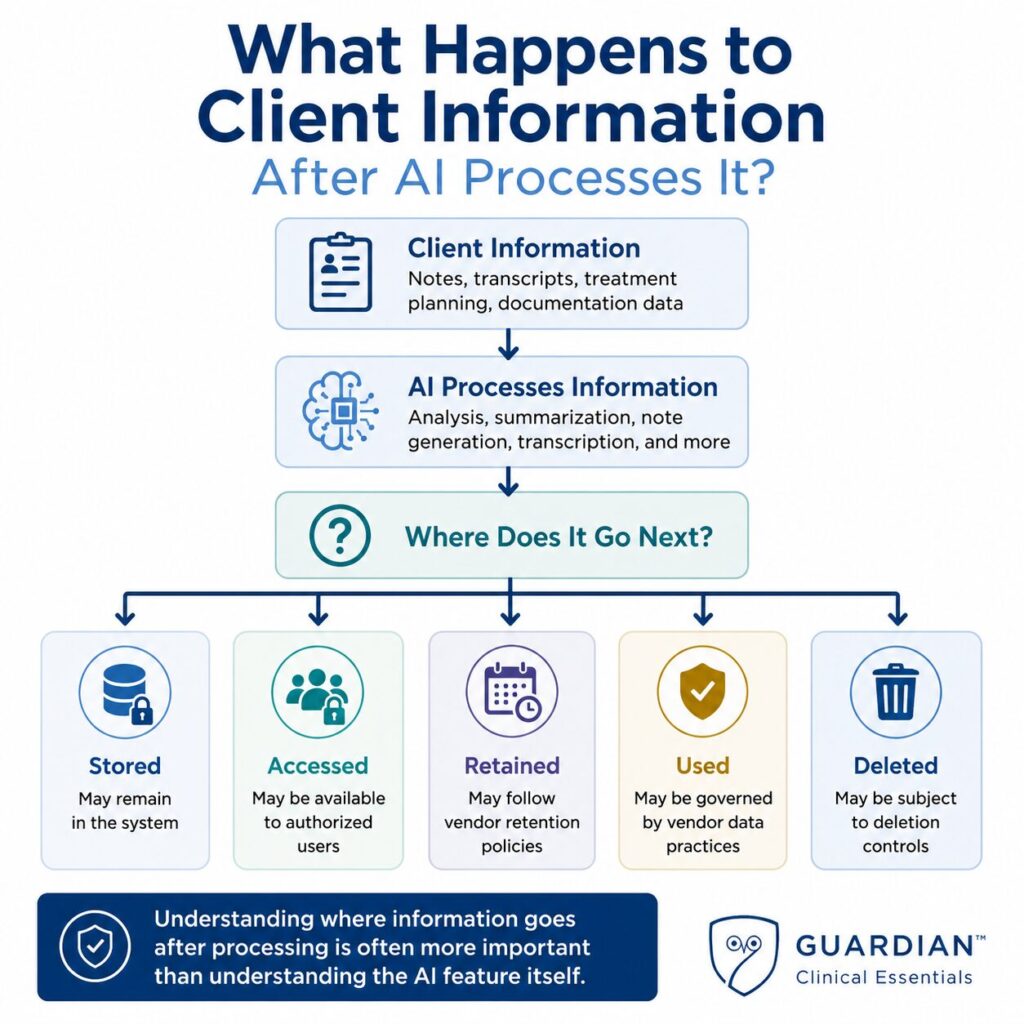
What Happens When Client Information Enters an AI Tool?
When client information enters an AI system, the information is received, processed, and used to generate some type of output. Depending on the tool, that output might be a progress note draft, treatment plan outline, session summary, transcript, email draft, or another task the platform was designed to perform.
From the therapist’s perspective, the process can feel straightforward. Information goes in, a response comes back, and the task is complete. The operational reality may be more complicated. The information may be transmitted between systems, stored temporarily or longer term, backed up, retained for account history, or handled according to the platform’s specific architecture and retention practices, concepts that align with how electronic protected health information is addressed within the HHS HIPAA Security Rule Overview.
This is one reason it can be difficult to make broad statements about AI. Two tools may appear very similar from the user’s perspective while handling information very differently behind the scenes. Understanding what happens after processing occurs often provides a clearer picture of risk than looking only at the output generated by the tool.
Client information does not necessarily disappear after AI generates a response.
A note, summary, transcript, or recommendation may appear finished from the therapist’s side, but the information used to create it may still be stored, retained, backed up, accessed, or governed by the vendor’s system. Before using AI with client information, therapists should understand where the information goes, how long it remains there, who can access it, and whether it can be deleted.
Where Does the Information Go After Processing?
A therapist may only interact with a single platform, but the information itself may move through several systems before a note, summary, or transcript is returned. Depending on how the tool is built, information could pass through cloud infrastructure, storage environments, integrated services, backup systems, or other technology that supports the platform’s functionality.
That does not automatically mean something inappropriate is happening. Healthcare technology often relies on multiple systems working together to provide a service. The challenge is that much of this activity is invisible to the end user, making it difficult to understand where information travels once processing begins.
One concept that comes up frequently in HIPAA compliance is following information through a workflow. This type of information mapping mirrors the risk analysis approach described in the HHS Security Risk Assessment Tool resources, which focus on identifying where electronic protected health information is created, received, maintained, and transmitted. The same approach can be helpful when evaluating AI tools. Rather than focusing only on the feature being used, therapists can benefit from understanding where information goes next, where it remains, and what happens to it after the output has been generated.
Does AI Store Client Information?
Storage is one of the reasons this question comes up so often. Many people assume the information disappears once the AI finishes generating a response. Depending on the platform, that may not be what happened at all.
Some systems retain very little information after processing occurs. Others store information for account history, troubleshooting, auditing, quality assurance, retrieval, or ongoing functionality. The answer depends on the vendor, the specific product being used, the service configuration, and the company’s retention practices.
Storage itself is not unusual. Therapy practices already use technology that stores protected health information every day, a reality reflected throughout the HHS HIPAA Privacy Rule information for professionals. Electronic health records, billing systems, telehealth platforms, secure communication tools, and practice management software all retain information in some form. The more useful question is not whether information is stored, but where it is stored, how long it remains there, and whether the practice understands how that storage fits into the larger workflow.
Who Can Access the Information?
Once information enters a system, therapists naturally want to know who can potentially see it. The answer may include authorized users within the practice, workforce members with approved access, administrators responsible for maintaining the platform, or others involved in supporting the service.
This is one area where vendor-specific details matter. Two companies offering similar features may have very different approaches to access controls, permissions, administration, and data management. Understanding who can access information requires looking beyond the AI feature itself and examining the environment surrounding it.
Questions about access are often less about the AI and more about the systems supporting it. The HIPAA framework places significant attention on access controls and workforce access management, both of which are discussed within the HHS Security Rule Administrative Safeguards guidance. Understanding who can interact with information throughout its lifecycle can provide a much clearer picture of how a platform handles client data.
Can Client Information Be Used to Train AI Models?
Questions about model training appear in almost every discussion about AI and HIPAA because therapists want to understand whether information entered into a system could become part of the tool’s future development.
The answer depends on the vendor, the product, the service level, and the agreements governing the relationship. Some companies state that customer information is not used for model training under certain plans or contractual arrangements. Others may have different practices depending on the product being used.
This is one reason it is worth reviewing vendor documentation carefully. Information about training practices is often found in privacy documentation, security materials, data processing agreements, and related resources rather than marketing language. The NIST Artificial Intelligence Risk Management Framework discusses governance, data management, and lifecycle considerations that can help organizations evaluate how information is handled throughout an AI system.
Can Information Be Deleted?
Another question that frequently follows discussions about storage and retention is whether information can be removed once it has entered a system.
The answer varies from one platform to another. Some vendors provide deletion controls directly to users. Others retain information for specific periods of time based on operational, contractual, or technical considerations. Information may also exist within backup environments that operate under different retention schedules than primary systems.
Understanding deletion practices is part of understanding the full lifecycle of information. If a therapist does not know how long information is retained, whether it can be deleted, or what happens after a deletion request is made, they may not have a complete picture of how the platform handles client data.
What Does This Mean for HIPAA?
The presence of AI does not automatically create a HIPAA problem. HIPAA does not prohibit providers from using technology, automation, cloud services, or artificial intelligence, provided they continue to meet applicable privacy and security obligations described in the HHS HIPAA for Professionals resources. The larger responsibility is understanding how protected health information is being handled and whether appropriate safeguards are in place.
The HHS HIPAA Security Rule Overview explains the requirements for safeguarding electronic protected health information and managing security risks within healthcare environments. Questions about where information travels, where it is stored, who can access it, how long it is retained, and what protections exist around it remain relevant regardless of whether the technology involves AI.
In many ways, the discussion comes back to understanding information flow. The technology may be new, but the process of evaluating how client information moves through a workflow is familiar territory within HIPAA compliance.
Stay Updated on Compliance Changes
Compliance expectations are constantly evolving, and most providers don’t hear about changes until they become a problem.
If you want clear, practical updates you can actually use, you can join my email list below.
The Bottom Line
A therapist may see a note, summary, transcript, or recommendation appear on the screen and assume the process is finished. Depending on the platform, the information that generated that output may still be moving through storage environments, retention systems, backup processes, or other parts of the vendor’s infrastructure.
That does not automatically mean there is a compliance problem. It does mean therapists benefit from understanding what happens after processing occurs. When practices understand where information goes, who can access it, how long it remains there, whether it can be deleted, and how it is governed throughout its lifecycle, they are in a much stronger position to evaluate whether a particular AI workflow aligns with their privacy, security, and compliance responsibilities.
FAQs
Can client information remain in an AI system after a note is generated?
Yes, client information may remain in an AI system after processing is complete.
Some platforms retain information for account history, troubleshooting, auditing, or other operational purposes. Others may retain very little information after generating a response. Understanding a vendor’s retention practices is an important part of evaluating how client information is handled.
Does AI automatically delete client information after processing?
No, AI systems do not automatically delete client information in every situation.
Deletion practices vary from one platform to another. Some systems allow users to delete information directly, while others may retain information for a period of time based on operational or technical requirements. Reviewing a vendor’s retention and deletion policies can provide a clearer picture of what happens after processing occurs.
Can AI vendors access client information?
Some AI vendors may have authorized personnel who can access certain information as part of maintaining or supporting their systems.
The extent of that access depends on the platform, its controls, and its operational processes. This is one reason it is important to understand who can access information throughout its lifecycle rather than focusing only on the AI feature itself.
Is storing client information the same as using it to train AI models?
No, storing information and using information for model training are separate issues.
A platform may retain information without using it to train AI models. Because practices vary between vendors, it is important to understand both the platform’s retention practices and its policies regarding model training.
Can information entered into an AI tool end up in backup systems?
Yes, information may exist in backup systems depending on how a platform is designed.
Backup environments often operate differently than primary storage systems and may follow separate retention schedules. Understanding how backups are handled can help therapists develop a more complete picture of how client information is managed.
Do therapists need to understand where client information goes after AI processes it?
Yes, understanding information flow is an important part of evaluating an AI tool.
A therapist may only interact with one platform, but the information itself may move through several systems before a result is returned. Following the information through the workflow often provides a clearer understanding of privacy, security, and compliance considerations.
Does using AI automatically create a HIPAA violation?
No, using AI does not automatically create a HIPAA violation.
The more important question is how client information is being handled within the workflow. Understanding where information goes, who can access it, how long it is retained, and what safeguards are in place helps practices evaluate whether a particular use of AI aligns with their compliance responsibilities.
Related Articles in This AI + HIPAA Series
Therapists exploring AI documentation often have additional questions that extend beyond progress notes alone.
Related topics include:
- AI + HIPAA: Resources Hub & Next Steps
- Is AI HIPAA Compliant for Therapists?
- Can Therapists Use ChatGPT for Progress Notes?
- Does a Business Associate Agreement Make AI HIPAA Compliant?
- What AI Risks Belong in a HIPAA Security Risk Analysis?
- Can Therapists Paste Client Information Into AI Tools?
- What Should an AI Policy Include for a Therapy Practice?
- Can Group Practices Allow Staff to Use AI Documentation Tools?
- Are AI Therapy Note Tools Safer Than Recording Sessions?
- Do You Need Client Consent to Use AI?
- Building AI for Therapy Practices: Behind the Scenes with Uriah Guilford
- Colorado’s New AI Law for Therapists: What Mental Health Practices Need to Change Now
Other Compliance Articles Coming Soon…
- Can Therapists Use AI for Treatment Plans?
- How Should Therapists Document AI Use in Practice?
About the Author
Samantha Schalk, LMSW-C, LMSW-M, CAADC, CIMHP, BCP3
Samantha is a licensed mental health professional, private and group practice owner, and the founder of Guardian Clinical Essentials™.
She helps therapists and group practices understand how compliance, documentation, privacy, technology, and practice operations work together in real-world clinical settings. Her work focuses on turning complex requirements into practical systems, policies, workflows, and implementation strategies that providers can actually use.
Drawing from experience in both clinical practice and compliance consulting, Samantha specializes in helping mental health professionals build defensible, sustainable systems that support both quality care and regulatory compliance.
Learn more about Samantha and Guardian Clinical Essentials™.

Continue Exploring Guardian Clinical Essentials™
Looking for additional compliance, privacy, AI, documentation, and practice operations resources?
Explore the Guardian Clinical Essentials™ Resource Library for educational articles, implementation guidance, training opportunities, and practical resources designed specifically for mental health professionals.