
Can Group Practices Allow Staff to Use AI Documentation Tools?
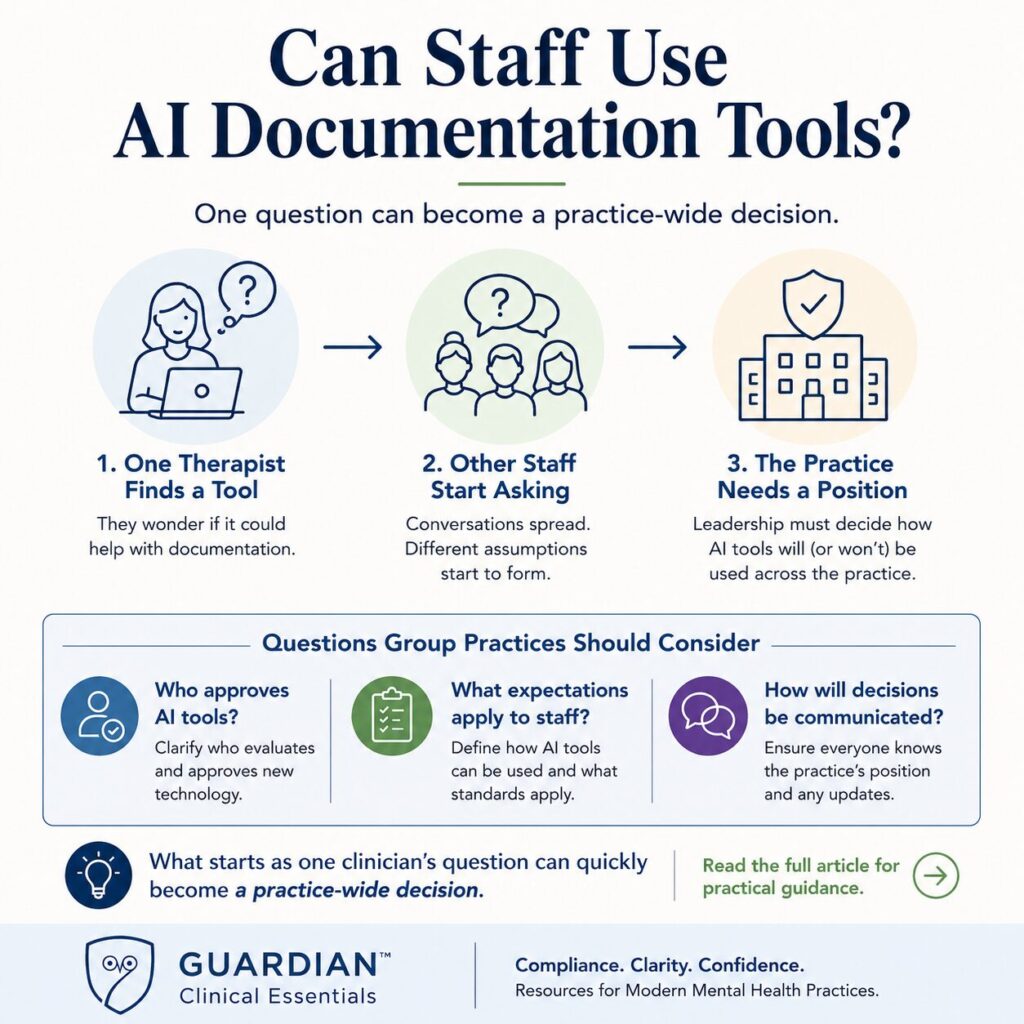
One of the interesting things about AI documentation tools is how quickly they can move from being an individual clinician question to a practice-wide decision.
A therapist attends a training and hears about a new tool. Someone sees a recommendation in a Facebook group. A clinician starts wondering whether there might be a faster way to complete documentation.
At first, it feels like a conversation about one person and one tool.
Before long, however, leadership realizes they are no longer talking about one therapist and one tool.
They are trying to figure out what the practice is actually going to do with AI.
Can staff use AI documentation tools? And if the answer is yes, who gets to decide which tools are acceptable, how they are used, and what expectations apply across the practice?
What starts as a technology question can quickly become a conversation about practice operations, consistency, and decision-making.
That is one reason many group practices are finding themselves having AI conversations whether they intentionally sought them out or not.
Can Group Practices Allow Staff to Use AI Documentation Tools?
The short answer is yes.
Many group practices are actively evaluating AI documentation tools and deciding whether they fit within their workflows, operational needs, and organizational goals.
What that decision looks like can vary significantly from one practice to another.
Some practices may decide to allow specific AI documentation tools. Others may permit limited use under defined circumstances. Some may decide not to allow AI documentation tools at all.
There is not a single answer that works for every organization.
What matters is that the practice has intentionally decided how it wants to approach AI documentation tools rather than discovering its position one clinician, one software demo, and one Facebook recommendation at a time.
As AI capabilities continue to expand across healthcare technology, the Office of the National Coordinator for Health Information Technology’s work on artificial intelligence and health IT highlights how rapidly AI functionality is becoming integrated into healthcare environments.
For many group practices, that means questions about AI are no longer hypothetical. They are showing up in staff conversations, software products, training programs, and workflow discussions today.
Who Should Decide Whether Staff Can Use AI Documentation Tools?
This is where group practices often encounter a challenge that solo practices do not face.
In a solo practice, the person using the technology is usually the same person making decisions about the technology.
In a group practice, those decisions often affect more than one person.
A clinician may be thinking about whether a tool helps them complete documentation more efficiently. Leadership may be thinking about staff expectations. Supervisors may be thinking about consistency across clinicians. Operations staff may be thinking about implementation and support.
All of those perspectives can matter.
That does not mean practice owners should make decisions without input. In fact, some of the most useful conversations happen when leadership gathers feedback from clinicians and staff members who will actually be using the technology.
At the same time, there still needs to be clarity around who is responsible for making final decisions.
Otherwise, practices can find themselves in the awkward position of realizing everyone has been operating under a different set of assumptions.
Why Individual Staff Preferences Are Not an AI Policy
One thing I have noticed is that clinicians often arrive at AI conversations from very different places.
Some are excited about the possibilities. Some are cautious. Some are actively exploring tools. Others have no interest in using them at all.
Most are simply trying to figure out what makes sense for their own workflow.
The challenge is that a practice can end up with several different approaches to AI without ever intentionally deciding what its approach should be.
A therapist may find a tool they like and assume it is acceptable because no one has said otherwise. Another clinician may avoid AI entirely because they assume it is prohibited. Someone else may be experimenting with a tool leadership has never reviewed.
None of those situations necessarily happen because someone is trying to ignore expectations.
Sometimes there simply are no expectations.
And when that happens, people tend to create their own.
That is often where practices begin to realize they need a clearer position.
The National Institute of Standards and Technology (NIST) Artificial Intelligence Risk Management Framework emphasizes the importance of organizational governance and consistent decision-making around AI systems.
An AI policy cannot answer every future question. It can, however, establish how decisions are made, who is responsible for making them, and what expectations apply across the organization.
What Happens When Nobody Decides?
Most group practices do not intentionally create multiple approaches to AI.
Sometimes they simply never create one approach at all.
A clinician finds a tool they like. Another staff member decides AI is off limits. Someone else starts using a feature leadership did not even realize existed.
None of those decisions may be malicious. They may not even be unreasonable.
The problem is that everyone is operating from a different set of assumptions.
Over time, the practice can end up with several unofficial approaches to AI without ever intentionally deciding what its actual position is.
What Happens When Different Staff Members Make Different AI Decisions?
Most group practices do not intentionally create multiple AI policies.
Sometimes they simply never create one at all.
When expectations are unclear, people naturally fill in the blanks for themselves.
One staff member may believe AI documentation tools are encouraged. Another may assume they are prohibited. A third may be using a tool leadership has never evaluated.
Over time, those differences can create confusion for staff, supervisors, and leadership.
The issue is not necessarily that anyone is acting inappropriately.
The issue is that the practice has never clearly communicated its position.
Group practices benefit from creating enough clarity that staff members are not left guessing about approvals, expectations, or decision-making processes related to AI documentation tools.
What Should Group Practices Consider Before Allowing AI Documentation Tools?
One thing I think is easy to overlook is that most group practices are not really deciding whether AI exists.
That decision has already been made for them.
Software vendors, technology companies, and developers are already building AI capabilities into products therapists use every day.
The question practices are actually trying to answer is how they want to respond.
For some organizations, that may mean allowing specific tools. For others, it may mean limiting use until additional evaluation occurs. Some may decide the technology is not the right fit for their practice at all.
Whatever the decision, practices generally benefit from thinking through how new tools will be evaluated, who is responsible for approving them, how expectations will be communicated, and what support staff may need if AI-related technologies are adopted.
The American Psychological Association’s ongoing guidance regarding artificial intelligence and professional practice considerations reflects the growing importance of thoughtful evaluation as clinicians and organizations encounter new AI-related technologies.
The goal is not to predict every future AI tool that may enter the market.
The goal is to create a decision-making process that remains useful as technology continues to evolve.
How Should Group Practices Communicate Expectations Around AI Use?
Even thoughtful decisions have limited value if staff members do not know they exist.
People should not have to guess whether AI documentation tools are permitted, restricted, under review, or prohibited.
They should not have to rely on assumptions, informal conversations, or information passed from one staff member to another.
Clear communication helps create consistency.
For some practices, those expectations may be documented in an AI policy. For others, they may also appear in employee handbooks, onboarding materials, training programs, technology policies, or operational procedures.
The specific format matters less than making sure expectations are clear, accessible, and consistently communicated.
When staff understand how decisions are made and what expectations apply, it becomes much easier to approach new technology in a thoughtful and organized way.
Stay Updated on Compliance Changes
Compliance expectations are constantly evolving, and most providers don’t hear about changes until they become a problem.
If you want clear, practical updates you can actually use, you can join my email list below.
Final Thoughts
Many group practices are not setting out to make decisions about AI documentation tools.
Often, the conversation begins because one clinician found a tool and asked a question.
Over time, that single question can become a broader discussion about expectations, consistency, leadership decisions, and how the practice wants to approach AI moving forward.
Group practices can absolutely choose to allow AI documentation tools.
The more important question is whether the practice has established a clear process for evaluating those tools and communicating expectations around their use.
As AI continues to become more common across healthcare technology, practices will likely encounter more of these conversations. Having a documented position can help ensure those decisions are made intentionally rather than one clinician, one recommendation, or one software feature at a time.
FAQs
Can a group practice allow some AI documentation tools but not others?
Yes.
A group practice does not have to take an all-or-nothing approach to AI documentation tools. Some practices choose to approve specific tools, limit certain uses, or require review before a new tool is adopted. The important part is that staff understand what the practice’s expectations are.
Do therapists need permission before using an AI documentation tool at work?
It depends on the practice’s expectations and approval process.
In some organizations, clinicians may be expected to obtain approval before using a new technology tool. In others, the expectations may be different. What matters is that the process is clear and consistently communicated.
What happens if different clinicians use different AI documentation tools?
Different expectations can develop across the practice.
That does not automatically create a problem, but it can lead to confusion if clinicians, supervisors, and leadership are all operating from different assumptions about what is permitted and how AI should be used.
Should AI documentation tools be addressed in an AI policy?
In many cases, yes.
If a practice has established expectations around AI documentation tools, an AI policy can help document those decisions and provide a consistent point of reference for staff.
Can a practice decide not to allow AI documentation tools?
Absolutely.
Some practices decide that AI documentation tools are not the right fit for their organization. Others may decide to revisit the issue later as technology continues to evolve. Either approach benefits from being intentional and clearly communicated.
Why do group practices end up with different expectations around AI use?
Because expectations are not always discussed before questions arise.
One clinician may assume AI tools are acceptable, while another assumes they are prohibited. Without a shared understanding, people often fill in the blanks for themselves.
Related Articles in This AI + HIPAA Series
Therapists exploring AI documentation often have additional questions that extend beyond progress notes alone.
Related topics include:
- AI + HIPAA: Resources Hub & Next Steps
- Is AI HIPAA Compliant for Therapists?
- Can Therapists Use ChatGPT for Progress Notes?
- Does a Business Associate Agreement Make AI HIPAA Compliant?
- What AI Risks Belong in a HIPAA Security Risk Analysis?
- Can Therapists Paste Client Information Into AI Tools?
- What Should an AI Policy Include for a Therapy Practice?
- Are AI Therapy Note Tools Safer Than Recording Sessions?
- What Happens to Client Information After AI Processes It?
- Do You Need Client Consent to Use AI?
- Building AI for Therapy Practices: Behind the Scenes with Uriah Guilford
- Colorado’s New AI Law for Therapists: What Mental Health Practices Need to Change Now
Other Compliance Articles Coming Soon…
- Can Therapists Use AI for Treatment Plans?
- How Should Therapists Document AI Use in Practice?
Sources
Office of the National Coordinator for Health Information Technology’s Work on Artificial Intelligence and Health IT
https://www.healthit.gov/topic/health-it-and-health-information-exchange-basics/artificial-intelligence-health-it
National Institute of Standards and Technology (NIST) Artificial Intelligence Risk Management Framework
https://www.nist.gov/itl/ai-risk-management-framework
American Psychological Association’s Artificial Intelligence Resources and Professional Practice Guidance
https://www.apa.org/topics/artificial-intelligence
About the Author
Samantha Schalk, LMSW-C, LMSW-M, CAADC, CIMHP, BCP3
Samantha is a licensed mental health professional, private and group practice owner, and the founder of Guardian Clinical Essentials™.
She helps therapists and group practices understand how compliance, documentation, privacy, technology, and practice operations work together in real-world clinical settings. Her work focuses on turning complex requirements into practical systems, policies, workflows, and implementation strategies that providers can actually use.
Drawing from experience in both clinical practice and compliance consulting, Samantha specializes in helping mental health professionals build defensible, sustainable systems that support both quality care and regulatory compliance.
Learn more about Samantha and Guardian Clinical Essentials™.

Continue Exploring Guardian Clinical Essentials™
Looking for additional compliance, privacy, AI, documentation, and practice operations resources?
Explore the Guardian Clinical Essentials™ Resource Library for educational articles, implementation guidance, training opportunities, and practical resources designed specifically for mental health professionals.