
Can Therapists Use ChatGPT for Progress Notes?
Therapists are already experimenting with AI documentation workflows whether organizations are officially talking about it or not.
Usually it starts with curiosity. A clinician uses AI to reorganize rough session notes after a long day. Someone asks a chatbot to tighten wording in a treatment plan. A group practice owner starts looking at AI scribes because documentation bottlenecks are affecting staff burnout and revenue.
The process tends to move quickly from curiosity to operational reality.
And honestly, some of the interest makes sense.
Documentation fatigue is real. Many therapists are carrying increasingly heavy caseloads while also trying to keep up with documentation, billing, coordination of care, client inquiries, caseload management, administrative work, all while remaining clinically present. When AI tools promise faster note completion, therapists pay attention.
A lot of the discussion around AI focuses on privacy, compliance, and technology. Those conversations matter. But when therapists start asking whether they can use ChatGPT for progress notes, they are often trying to solve a much more practical problem.
They are trying to get their notes done.
The challenge is that progress notes occupy a unique place in clinical practice. They are not simply administrative tasks. They are part of the clinical record and a reflection of the therapist’s professional judgment.
That is why AI documentation conversations tend to become more nuanced over time. What begins as a question about efficiency eventually becomes a conversation about documentation, accountability, authorship, and defensibility.
Once AI enters the process, the question is no longer simply what the technology can do.
The question becomes whether the documentation still reflects the therapist’s clinical thinking once automation becomes part of the workflow.
Should Therapists Use ChatGPT to Help With Documentation?
In some situations, therapists may choose to use AI-assisted workflows to support documentation tasks. The more useful question is often not whether AI can be used, but how it is being used and what role it plays in the documentation process.
A therapist who uses AI to improve readability, organize ideas, or format information after drafting a note is operating very differently from a clinician who relies on AI to generate large portions of the clinical record. Those distinctions matter because they affect authorship, review, privacy considerations, and ultimately documentation defensibility.
One thing I have noticed in conversations about AI documentation is that therapists often focus on the technology first. The conversation quickly becomes about ChatGPT, AI scribes, or documentation software. But many of the questions that emerge later have less to do with the technology itself and more to do with workflow.
How much information is being shared? Who is reviewing the output? How does the note ultimately make its way into the chart? What happens if the generated content is inaccurate?
Those are implementation questions, but they often become compliance questions later.
That is part of what makes AI documentation conversations more complicated than they initially appear. The technology may be new, but many of the underlying concerns involve documentation practices, professional judgment, oversight, and accountability that therapists have always been responsible for managing.
Can AI-Generated Notes Create Documentation Problems?
They can, even when the note itself sounds polished.
A note may read smoothly while still containing assumptions, omissions, or language that the therapist would not have chosen independently. Generative AI systems can sometimes produce inaccurate information while presenting it confidently, which is one reason careful human review remains important in professional documentation workflows. The NIST Artificial Intelligence Risk Management Framework discusses reliability, validity, and risk management considerations that organizations should evaluate when implementing AI systems.
One thing that makes this challenging is that polished writing can create a false sense of confidence. The note sounds professional. The structure looks organized. The wording feels complete.
Those qualities are useful, but they are not the same thing as clinical accuracy.
Over time, therapists may spend less energy evaluating what the note actually says because the writing itself feels competent. I’ve started noticing that this is where many AI documentation conversations become more interesting. The concern is not whether AI can generate convincing language. It clearly can. The concern is whether the final note still reflects the therapist’s clinical thinking, observations, and decision-making.
Documentation defensibility depends on more than readability.
A progress note may eventually be reviewed by insurance companies, auditors, licensing boards, attorneys, supervisors, or other providers involved in care. In those situations, the question is not whether the note sounds professional.
The question is whether it accurately reflects the session and the clinician’s judgment.
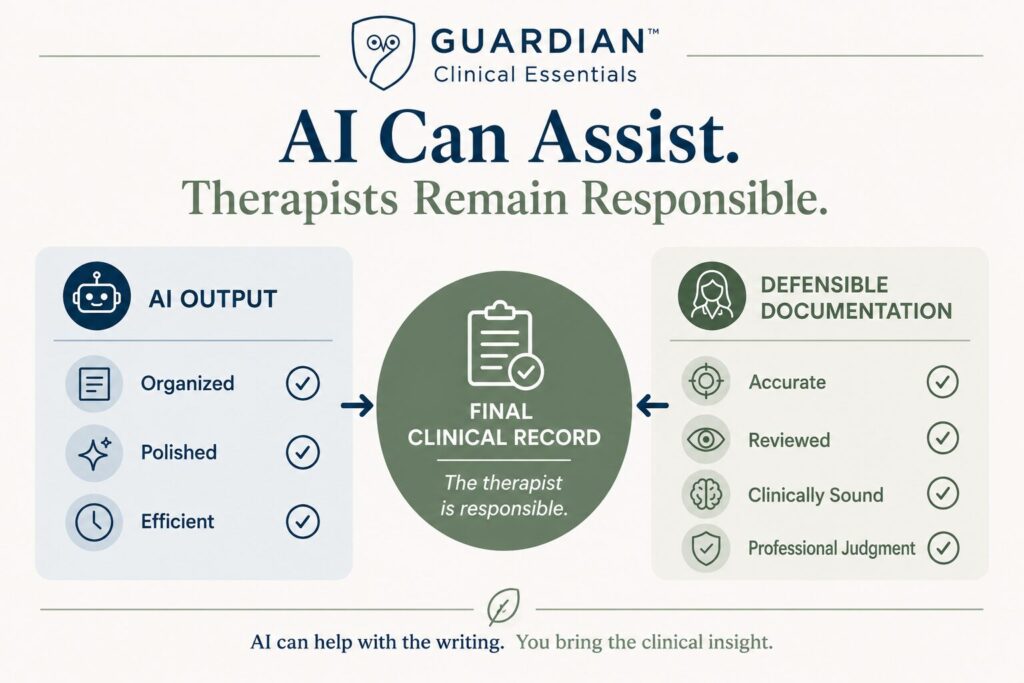
AI can help with writing and organization, but documentation defensibility still depends on clinical judgment, accuracy, and human review.
Can AI Affect Clinical Judgment in Documentation?
One of the more interesting aspects of AI documentation is that its influence is not always obvious.
Most therapists are not intentionally trying to hand clinical judgment over to technology. In fact, most clinicians exploring AI documentation are trying to stay involved in the process while reducing administrative burden.
But documentation habits can shift gradually.
Therapists make documentation decisions all day without thinking much about them. What gets included. What gets left out. What needs additional context. What needs less. How a clinical concern is described. How risk is documented. How progress is summarized.
Those decisions are part of clinical judgment.
AI can generate language quickly, but it does not exercise judgment in the same way a clinician does.
One thing I’ve started paying attention to in AI documentation conversations is how quickly polished language can become trusted language. If a note sounds professional, it is easy to assume the underlying documentation is equally strong.
Those are not always the same thing.
Experienced therapists know there are sessions where the most defensible note is not the longest note. Sometimes good documentation involves restraint. Sometimes it involves carefully choosing what belongs in the record and what does not.
AI systems do not naturally understand those distinctions in the same way clinicians do.
The result is not necessarily poor documentation.
But over time it can become documentation that sounds increasingly polished while feeling less connected to the therapist’s actual clinical reasoning.
Do Therapists Still Need to Review AI-Generated Notes?
Absolutely.
Human review is probably the most important safeguard in any AI-assisted documentation workflow. The American Medical Association’s Augmented Intelligence resources similarly emphasize the importance of physician oversight and accountability when AI tools are incorporated into clinical workflows.
Review means more than checking for spelling errors or making small edits before signing the note.
The therapist still needs to determine whether the documentation accurately reflects the session, whether the language matches their clinical reasoning, and whether the record would make sense if reviewed months or years later.
This becomes especially important in situations involving higher clinical complexity, elevated risk, crisis work, trauma treatment, or legal scrutiny.
The responsibility for the final note still belongs to the clinician. That expectation is consistent with broader healthcare documentation standards, where providers remain responsible for the accuracy and completeness of the clinical record regardless of the tools used during the documentation process.
That does not change because AI participated somewhere in the drafting process.
Can AI Affect Documentation Defensibility?
A note can be well written and still be difficult to defend.
AI can improve organization, readability, and efficiency. Documentation defensibility still depends on accuracy, clinical judgment, meaningful review, and accountable professional authorship.
Those are responsibilities that remain with the therapist regardless of how the documentation was created.
Is ChatGPT HIPAA Compliant for Therapy Notes?
This is one of the most common questions therapists ask, but it is often tied to a larger conversation about implementation, privacy, and compliance.
The answer is not always straightforward, and it involves considerations that extend beyond documentation alone.
For therapists trying to decide whether AI-assisted documentation makes sense for their practice, the more immediate question is often whether the workflow itself is appropriate, defensible, and consistent with their professional responsibilities.
Questions about HIPAA compliance, AI-related privacy risks, and the handling of protected health information deserve deeper discussion than this article can provide and are worth evaluating separately. Therapists looking for foundational information can review the HHS HIPAA Privacy Rule Overview, which explains privacy protections and responsibilities related to protected health information.
Should Therapists Avoid AI Documentation Completely?
Not necessarily.
Many therapists are exploring AI because the administrative burden of practice continues to grow. That reality is unlikely to change any time soon.
The more useful distinction is not between therapists who use AI and therapists who do not.
It is between therapists who remain actively engaged in the documentation process and therapists who gradually hand more of that process over to automation.
Those are very different approaches.
One theme that shows up repeatedly in compliance and risk management conversations is that technology rarely creates risk on its own. More often, risk develops when new technology enters existing workflows without clear expectations, oversight, or review.
AI documentation is no different.
The question is not whether a therapist used AI somewhere in the process.
The question is whether the workflow remains thoughtful, accountable, and professionally defensible once AI becomes part of it.
Most clinicians can usually feel the difference.
That instinct is often worth paying attention to.
Stay Updated on Compliance Changes
Compliance expectations are constantly evolving, and most providers don’t hear about changes until they become a problem.
If you want clear, practical updates you can actually use, you can join my email list below.
A More Useful Way to Think About AI Documentation
A lot of AI discussions begin with efficiency.
That makes sense. Therapists are busy. Documentation burden is real. Most clinicians are not looking for shortcuts because they care less about documentation. They are looking for ways to spend less time on administrative tasks and more time focused on clients.
But over time, I suspect the more useful conversation becomes one of authorship and accountability.
Can the therapist explain how the note was created?
Was the documentation meaningfully reviewed before becoming part of the record?
Does the final note accurately reflect the clinician’s judgment and understanding of the session?
Would the therapist feel comfortable standing behind the workflow if the note were later reviewed by a payer, attorney, licensing board, or auditor?
Those questions often bring more clarity than debates about individual AI tools.
Because ultimately, the issue is not whether AI participated somewhere in the documentation process.
The issue is whether the clinical record still reflects accountable professional judgment once automation becomes part of the workflow. As healthcare organizations continue evaluating AI tools, federal agencies and standards organizations are increasingly emphasizing governance, oversight, risk management, and human accountability alongside technological innovation.
That is the question therapists will likely continue grappling with as AI becomes more common throughout healthcare documentation.
FAQs
Can AI-generated notes sound accurate even when they are wrong?
Yes.
One of the challenges with AI-generated documentation is that it often sounds polished and clinically appropriate. Therapists may be more likely to overlook inaccuracies when the writing feels professional and well organized, which is why careful review remains so important.
Can therapists use AI to rewrite notes they have already written?
Sometimes.
Some therapists use AI to improve readability, organization, or formatting after drafting a note themselves. Whether that workflow is appropriate depends on much more than the writing itself. Therapists should consider privacy, security, and compliance implications before incorporating AI into their documentation process. The therapist remains responsible for the final clinical record and should carefully review any AI-generated content before it becomes part of the chart.
Can AI-generated notes create insurance audit concerns?
Potentially.
Auditors are generally focused on whether documentation accurately supports the services provided. AI-generated notes may create concerns if they contain inaccurate information, unsupported clinical statements, or documentation that does not reflect what actually occurred during treatment.
Can AI make progress notes too detailed?
Yes.
AI systems often generate more content than is clinically necessary. More detail does not automatically create better documentation and may sometimes introduce information that adds little value to the clinical record.
What if AI adds information that was never discussed in session?
Correct it.
Therapists should carefully review AI-generated notes and remove any information that was not discussed, observed, or clinically supported. The final note should reflect what actually occurred during treatment, not what the AI predicted or inferred.
Can therapists use AI for SOAP notes, DAP notes, or BIRP notes?
They can.
Some therapists use AI to help organize information into documentation formats such as SOAP, DAP, or BIRP notes. The therapist should still review the content to ensure it accurately reflects the session, their interventions, and their clinical judgment.
Does using AI actually make documentation faster?
Sometimes.
Time savings vary significantly. Some clinicians find AI reduces documentation time, while others spend substantial time reviewing and editing generated content. The amount of time saved often depends on the workflow, the quality of the output, and how much oversight is required before the note is finalized.
Can AI-generated notes affect documentation defensibility?
Yes.
Documentation defensibility depends on whether the final record accurately reflects the therapist’s professional judgment, treatment decisions, and clinical reasoning. A note can be well written and still be difficult to defend if it contains inaccurate information or language the therapist cannot confidently stand behind.
Related Articles in This AI + HIPAA Series
Therapists exploring AI documentation often have additional questions that extend beyond progress notes alone.
Related topics include:
- AI + HIPAA: Resources Hub & Next Steps
- Is AI HIPAA Compliant for Therapists?
- Does a Business Associate Agreement Make AI HIPAA Compliant?
- What AI Risks Belong in a HIPAA Security Risk Analysis?
- Can Therapists Paste Client Information Into AI Tools?
- What Should an AI Policy Include for a Therapy Practice?
- Can Group Practices Allow Staff to Use AI Documentation Tools?
- Are AI Therapy Note Tools Safer Than Recording Sessions?
- What Happens to Client Information After AI Processes It?
- Do You Need Client Consent to Use AI?
- Building AI for Therapy Practices: Behind the Scenes with Uriah Guilford
- Colorado’s New AI Law for Therapists: What Mental Health Practices Need to Change Now
Other Compliance Articles Coming Soon…
- Can Therapists Use AI for Treatment Plans?
- How Should Therapists Document AI Use in Practice?
Sources
[1] National Institute of Standards and Technology (NIST). Artificial Intelligence Risk Management Framework (AI RMF 1.0). https://www.nist.gov/itl/ai-risk-management-framework
[2] U.S. Department of Health and Human Services (HHS). HIPAA Privacy Rule Overview. https://www.hhs.gov/hipaa/for-professionals/privacy/index.html
[3] American Medical Association (AMA). Augmented Intelligence in Health Care. https://www.ama-assn.org/practice-management/digital/augmented-intelligence-health-care
About the Author
Samantha Schalk, LMSW-C, LMSW-M, CAADC, CIMHP, BCP3
Samantha is a licensed mental health professional, private and group practice owner, and the founder of Guardian Clinical Essentials™.
She helps therapists and group practices understand how compliance, documentation, privacy, technology, and practice operations work together in real-world clinical settings. Her work focuses on turning complex requirements into practical systems, policies, workflows, and implementation strategies that providers can actually use.
Drawing from experience in both clinical practice and compliance consulting, Samantha specializes in helping mental health professionals build defensible, sustainable systems that support both quality care and regulatory compliance.
Learn more about Samantha and Guardian Clinical Essentials™.

Continue Exploring Guardian Clinical Essentials™
Looking for additional compliance, privacy, AI, documentation, and practice operations resources?
Explore the Guardian Clinical Essentials™ Resource Library for educational articles, implementation guidance, training opportunities, and practical resources designed specifically for mental health professionals.