
What Should an AI Policy Include for a Therapy Practice?
One thing I am seeing right now is that therapists tend to have pretty strong feelings about AI.
Some are jumping on the bandwagon with both feet. They are trying new documentation tools, experimenting with automation, and exploring every new AI feature that seems to appear overnight.
Others are avoiding it like the plague.
And the reasons for that vary. For some therapists, the concerns center around privacy and compliance. For others, it is questions about job security, environmental impact, or whether AI belongs in the work we do at all.
What I find interesting is that both groups are often focused on the technology itself.
The therapists embracing AI are trying to figure out how to use it safely. The therapists avoiding AI are trying to figure out how to avoid the risks. Both are reasonable conversations to have. At the same time, there is another question that practices need to answer regardless of where they fall on that spectrum.
How is the practice going to approach AI?
Whether your practice plans to use AI extensively, use it in limited ways, or avoid it altogether, your practice should still have an AI policy.
An AI policy is not just for practices that are enthusiastic about incorporating artificial intelligence. It helps create clarity around the practice’s position on AI and provides guidance for how the practice will approach these tools as the technology continues to evolve.
That does not mean the policy needs to anticipate every new platform, feature, or future development in artificial intelligence. Technology changes too quickly for that to be realistic. Instead, the policy serves as a foundation for how the practice thinks about AI, how decisions will be made, and what expectations exist around its use.
Do Therapists Need an AI Policy?
As artificial intelligence becomes more integrated into the software therapists use every day, I think the question is becoming less about whether a practice should have an AI policy and more about what that policy should say.
Part of the reason is that AI is no longer limited to tools that therapists intentionally seek out. AI features are increasingly being incorporated into EHRs, scheduling systems, productivity software, and other technology platforms used throughout healthcare. The Office of the National Coordinator for Health Information Technology’s work on artificial intelligence and health IT highlights just how rapidly AI capabilities are being integrated into healthcare technology environments.
That creates a challenge for practices that have never formally discussed their position on artificial intelligence. Not because anyone is necessarily doing anything wrong, but because people may be operating from different assumptions. One person may assume certain uses are acceptable. Another may assume they are not. Leadership may have one perspective while staff members have another. Until those conversations happen, everyone is essentially filling in the blanks for themselves.
That is where an AI policy becomes helpful.
At its simplest, an AI policy is a way to document the practice’s position on artificial intelligence and create clarity around how the organization intends to approach it. The policy creates a shared point of reference when questions arise, new technologies emerge, or different opinions exist within the practice about how AI should or should not be used.
Whether a practice ultimately embraces AI, limits it, or decides to avoid it altogether, there is value in having those decisions documented. As the National Institute of Standards and Technology (NIST) Artificial Intelligence Risk Management Framework emphasizes, organizations benefit from establishing governance structures and decision-making processes that support the responsible use of AI technologies.
Do I Need an AI Policy if I’m Not Using AI?
This is where I think AI policies are often misunderstood.
Many therapists hear the phrase “AI policy” and immediately assume it is a document for practices that have already embraced artificial intelligence. I do not necessarily see it that way.
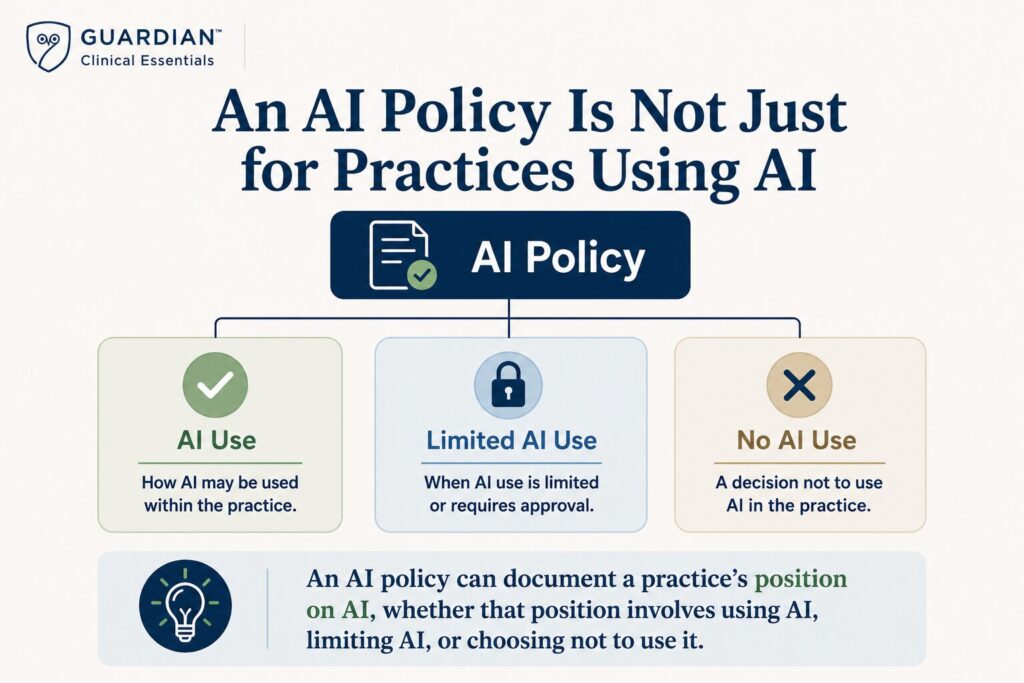
An AI policy can absolutely describe how a practice uses AI. It can also describe how a practice limits AI use, restricts certain applications, or chooses not to use AI at all. The policy is not just documenting what the practice does. It is documenting the practice’s position.
For some therapists, that position may be that AI has no place in clinical work. For others, it may be that AI can be used in limited circumstances but not others. Still others may be actively exploring how AI fits into practice operations. Those positions are very different, but they all benefit from being intentional and documented.
The reality is that therapists may decide not to use AI while still encountering AI-powered features in software products, search engines, documentation systems, and other technology platforms. The American Psychological Association’s ongoing guidance regarding artificial intelligence and professional practice considerations reflects the growing need for clinicians to understand and evaluate AI-related issues regardless of their current level of adoption.
Having a documented position gives the practice a starting point for answering future questions about AI rather than trying to make every decision from scratch.
What Is an AI Policy Actually Documenting?
Many therapists think of an AI policy as a document that explains how artificial intelligence can be used within a practice.
It can do that.
It can also document when AI cannot be used, when leadership approval is required, or when a practice has chosen not to use AI at all.
An AI policy is not simply documenting technology.
It is documenting the practice’s position on artificial intelligence.
That distinction often makes it easier to understand why practices may benefit from an AI policy even when they are not actively using AI tools.
What Should an AI Policy Include?
One thing I appreciate about this question is that it moves the conversation beyond whether AI is good or bad.
Eventually, every practice reaches a point where it has to decide what its position actually is.
That does not mean every AI policy needs to look the same. In fact, I would expect AI policies to look very different from one practice to another because therapists are approaching artificial intelligence in very different ways. A solo practitioner who has decided not to use AI at all has different considerations than a group practice that is actively evaluating AI tools. A practice that is cautiously exploring administrative uses may have a very different policy than a practice that has chosen to avoid AI entirely.
At a minimum, an AI policy should clearly communicate the practice’s position on AI and provide enough guidance that people understand how the practice intends to approach the technology moving forward. The policy should answer the questions that are most likely to arise within the organization and provide a consistent point of reference when those questions come up.
For some practices, the policy may focus primarily on limitations and boundaries. For others, it may focus on acceptable uses and operational expectations. In many cases, it will include a combination of both.
The goal is not to create a policy that covers every possible scenario. It is to create enough clarity that people understand the practice’s position, who is responsible for making decisions about AI, and what expectations exist around its use.
The goal is not to anticipate every future development in artificial intelligence. Technology is changing too quickly for that approach to be practical. Instead, the policy should provide enough clarity that the practice is not reinventing its position every time a new AI tool, feature, or workflow enters the conversation.
How Often Should an AI Policy Be Reviewed and Updated?
One of the realities of writing about artificial intelligence is that the conversation changes quickly.
New tools are being released, existing products are adding AI functionality, and therapists are encountering new use cases on a regular basis. A policy that accurately reflects a practice’s position today may not reflect that same position a year from now.
That does not mean practices need to rewrite their AI policies every few months.
What it does mean is that AI policies benefit from periodic review. A policy should continue to reflect the reality of how the practice operates, the technology it uses, and the decisions leadership has made regarding artificial intelligence. Periodic review helps ensure the policy continues to align with current technology, workflows, and organizational decisions.
In some cases, a review may result in no changes at all. In other cases, a practice may decide that its position has evolved as it has gained more experience with AI or as new technologies have emerged.
Technology will continue to change. An AI policy should continue to provide clarity, even as the answers themselves evolve.
Stay Updated on Compliance Changes
Compliance expectations are constantly evolving, and most providers don’t hear about changes until they become a problem.
If you want clear, practical updates you can actually use, you can join my email list below.
Final Thoughts
AI policies are often discussed as though they only matter for practices that have already decided to embrace artificial intelligence.
What I am seeing is something a little different.
Some therapists are enthusiastically exploring AI. Others are intentionally avoiding it. Most seem to be somewhere in between, trying to make thoughtful decisions while the technology continues to evolve around them.
Regardless of where a practice lands, there is value in having a documented position.
An AI policy does not need to predict the future, answer every possible question, or anticipate every new technology that enters the market. It simply needs to create enough clarity that the practice can make consistent decisions as new questions arise.
For some practices, that policy may support limited AI use. For others, it may establish clear boundaries around what is and is not acceptable. The specific position matters less than the fact that the position has been considered, documented, and communicated.
As artificial intelligence becomes increasingly integrated into healthcare technology, having that foundation in place can help practices approach future decisions with greater consistency and confidence.
FAQs
Does an AI policy need to be a separate document?
Not necessarily.
Some therapy practices create a standalone AI policy, while others incorporate AI expectations into broader technology, privacy, or operational policies. What matters most is that the practice’s position on AI is documented clearly and can be communicated consistently.
Can a therapy practice prohibit AI use entirely?
Yes.
An AI policy can document a decision not to use artificial intelligence just as easily as it can document approved uses. The purpose of the policy is to create clarity around how the practice approaches AI.
Who should help create an AI policy?
It depends on the size of the practice.
In a solo practice, the owner may be the only person involved. In larger organizations, leadership may want input from clinical, operational, compliance, and technology stakeholders before finalizing the policy.
Should an AI policy change when software vendors add new AI features?
Potentially.
Many software platforms are introducing AI functionality into existing products. When those changes affect how a practice uses technology, it may make sense to review whether the AI policy still reflects current operations and decision-making.
What is the primary purpose of an AI policy?
Clarity.
An AI policy helps document how a practice approaches artificial intelligence so that future decisions can be made more consistently as technology continues to evolve.
Do I still need an AI policy if I do not use AI in my practice?
Generally, yes.
An AI policy is not just a document for practices actively using artificial intelligence. It can also document a decision not to use AI, establish boundaries around future AI adoption, and provide guidance if AI features appear within software platforms the practice already uses.
Many therapists assume an AI policy only becomes relevant after they begin using AI tools. In reality, documenting a practice’s position before AI use occurs can help create clarity and consistency if questions arise later.
Should solo therapists have an AI policy?
Generally, yes.
AI policies are not just for large organizations or group practices. Solo therapists may also benefit from documenting their position on AI, especially as artificial intelligence becomes more common within documentation systems, productivity tools, and healthcare technology platforms. A written policy can provide a consistent framework for future decisions, even when only one person is making them.
Related Articles in This AI + HIPAA Series
Therapists exploring AI documentation often have additional questions that extend beyond progress notes alone.
Related topics include:
- AI + HIPAA: Resources Hub & Next Steps
- Is AI HIPAA Compliant for Therapists?
- Can Therapists Use ChatGPT for Progress Notes?
- Does a Business Associate Agreement Make AI HIPAA Compliant?
- What AI Risks Belong in a HIPAA Security Risk Analysis?
- Can Therapists Paste Client Information Into AI Tools?
- Can Group Practices Allow Staff to Use AI Documentation Tools?
- Are AI Therapy Note Tools Safer Than Recording Sessions?
- What Happens to Client Information After AI Processes It?
- Do You Need Client Consent to Use AI?
- Building AI for Therapy Practices: Behind the Scenes with Uriah Guilford
- Colorado’s New AI Law for Therapists: What Mental Health Practices Need to Change Now
Other Compliance Articles Coming Soon…
- Can Therapists Use AI for Treatment Plans?
- How Should Therapists Document AI Use in Practice?
Sources
Office of the National Coordinator for Health Information Technology (ONC): Artificial Intelligence and Health IT
https://www.healthit.gov/topic/health-it-and-health-information-exchange-basics/artificial-intelligence-health-it
National Institute of Standards and Technology (NIST): Artificial Intelligence Risk Management Framework (AI RMF 1.0)
https://www.nist.gov/itl/ai-risk-management-framework
American Psychological Association (APA): Artificial Intelligence
https://www.apa.org/topics/artificial-intelligence
About the Author
Samantha Schalk, LMSW-C, LMSW-M, CAADC, CIMHP, BCP3
Samantha is a licensed mental health professional, private and group practice owner, and the founder of Guardian Clinical Essentials™.
She helps therapists and group practices understand how compliance, documentation, privacy, technology, and practice operations work together in real-world clinical settings. Her work focuses on turning complex requirements into practical systems, policies, workflows, and implementation strategies that providers can actually use.
Drawing from experience in both clinical practice and compliance consulting, Samantha specializes in helping mental health professionals build defensible, sustainable systems that support both quality care and regulatory compliance.
Learn more about Samantha and Guardian Clinical Essentials™.

Continue Exploring Guardian Clinical Essentials™
Looking for additional compliance, privacy, AI, documentation, and practice operations resources?
Explore the Guardian Clinical Essentials™ Resource Library for educational articles, implementation guidance, training opportunities, and practical resources designed specifically for mental health professionals.