
Building AI for Therapy Practices
Behind the Scenes with Uriah Guilford
I’ve spent the last year talking with therapists about artificial intelligence. Most of those conversations tend to revolve around the same questions.
Is it HIPAA compliant? Is it secure? Is this something I should even be using? What happens if it gets something wrong? And perhaps most commonly, does AI belong in a therapy practice in the first place?
They’re good questions, and I expect we’ll continue asking them for quite some time. Recently, though, I realized there was a perspective I hadn’t spent much time exploring.
What does it actually look like to build AI specifically for therapy practices?
I wanted to understand what happens behind the scenes. How do you prepare for crisis situations? What kinds of safeguards do you put in place? How do you test for things you may not have anticipated? And what do you learn after spending a year building and refining a platform that therapists are actually using?
That question led me to a conversation with therapist and entrepreneur Uriah Guilford. Many therapists know Uriah through Productive Therapist, where he has spent years helping practice owners improve intake processes and practice operations. More recently, he has been developing an AI-powered intake and receptionist platform for therapy practices, giving him a different perspective on many of the questions therapists are currently asking about AI.
Our conversation had very little to do with AI being “the future” of therapy. We talked about testing, implementation problems, privacy, crisis situations, human oversight, and the limitations of the technology itself. It was a much more practical conversation than many of the conversations happening around AI right now.
Building AI for therapy practices isn’t simply a matter of figuring out what the technology can do. It also means deciding what it should do, what it shouldn’t do, and what happens when real people use it in ways you didn’t anticipate.
Why Build AI for Therapy Practices in the First Place?
Uriah didn’t set out to build an AI platform. He started by trying to solve a problem.
After beginning his career as a therapist and later growing a group practice, he found himself dealing with a challenge that will sound familiar to many practice owners: intake. Prospective clients often reach out at the exact moment they’re ready to seek help. If no one answers the phone or responds quickly, they may move on to another practice.
That problem ultimately led to Productive Therapist, his virtual assistant company, which has spent the better part of the last decade supporting therapists with intake coordination and administrative workflows. Over time, therapists kept asking for something more: Could someone answer the phone live?
Practices wanted faster response times and more immediate support for prospective clients, but providing live phone coverage across multiple practices isn’t always easy to scale with a human team alone. Then, about a year ago, Uriah began experimenting with AI voice agents.
“I was surprised that they had gotten so good,” he told me.
That experimentation eventually led to the development of an AI-supported intake platform that is now being used by dozens of therapy practices.
I think the path to building it is worth paying attention to because the starting point wasn’t AI. It was intake. That can easily get lost right now, with new AI products appearing constantly and therapists being told about all the different ways they can use them.
Starting with the technology can put the decision-making process backward. A better starting point is the problem you’re trying to solve. For Uriah, that problem was how to respond to prospective clients more quickly while providing the kind of live coverage practices had been asking for. AI became one possible way to address it.
What Therapists Don’t See Behind the Scenes of AI
Testing came up repeatedly during my conversation with Uriah. I expected to hear more about features and what the technology could do. Instead, we spent a surprising amount of time talking about what could go wrong.
“We’ve tested it extensively and tried to break it,” Uriah told me. “What happens if somebody says this? What happens if they say they’re suicidal? What happens if they ask this random question?”
By the time therapists encounter an AI tool, they’re usually seeing something relatively polished. They don’t see the months spent testing unusual situations, refining prompts, finding problems, and deciding how the system should respond when a conversation goes somewhere unexpected. That process is relevant when practices evaluate AI products.
A Business Associate Agreement matters. How Protected Health Information is handled matters. Security safeguards matter. But those aren’t the only things that tell us something about the product we’re considering. The way a company tests its technology matters too.
A practice can ask a vendor how the system was tested, what happens when it encounters something outside its intended function, what limitations have been identified, and how problems are addressed after the product is already being used.
Uriah also described deliberately limiting what the platform is allowed to do. That stood out in an environment where AI products are often promoted based on how much they can do.
An AI receptionist doesn’t need to do everything. It may need to answer common intake questions, collect certain information, or help someone schedule an appointment. That doesn’t mean it should move beyond those tasks into areas requiring clinical judgment.
Therapists already understand this concept through scope of practice. We know that competence in one area doesn’t automatically create competence in another. AI tools have a scope too.
A voice agent answering a practice phone has a different function and different risks than an AI documentation assistant. Both are different from a chatbot interacting with clients or a tool offering clinical decision support. Simply asking whether a practice “uses AI” doesn’t tell us very much. What the AI is being asked to do makes a significant difference.
Before You Bring AI Into Your Practice
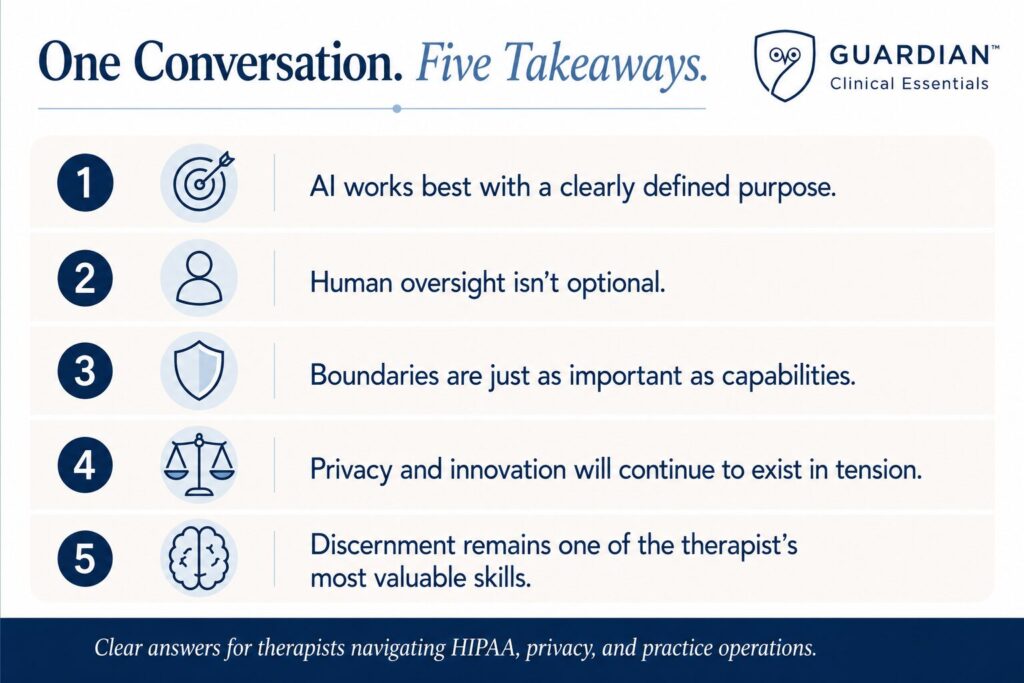
Knowing what an AI tool can do is only part of the evaluation. You also need to understand what it was designed to do, where its limits are, how it has been tested, and what happens when something doesn’t go as expected.
The goal isn’t to find an AI tool with no limitations. It’s to understand those limitations before the tool becomes part of your practice.
Can AI Handle Crisis Situations?
At some point, nearly every conversation about AI in mental health arrives at the crisis question: What happens if someone says they’re suicidal?
That was something I specifically wanted to ask Uriah about because an AI receptionist may be interacting with someone before that person ever becomes a client of the practice.
According to Uriah, crisis scenarios were considered early in the development process. If someone indicates that they are suicidal or experiencing an emergency, the platform is designed to provide predetermined responses directing them to appropriate crisis resources and emergency services.
That doesn’t mean the AI is assessing risk or managing a clinical crisis. An AI receptionist can recognize certain situations and respond according to the parameters it has been given. It cannot conduct a clinical risk assessment, provide therapeutic support, or exercise the judgment of a trained mental health professional.
For a practice considering this type of technology, the important question is not simply whether the company has a crisis response. The practice needs to understand what that response actually consists of and what happens after it is triggered.
There is also some context worth keeping in mind here. Risk isn’t unique to AI. A human receptionist can misunderstand what someone is saying. An email can go unread. A voicemail left Friday evening may not be heard until Monday morning.
Practices already make decisions about how urgent communications are handled and what clients and prospective clients are told to do in an emergency. AI adds another workflow that needs to be examined. The practice still has to determine where the technology fits, where its responsibility ends, and what procedures need to exist around it.
Why Human Oversight Still Matters
At one point, Uriah compared AI to a pre-licensed therapist. The analogy made me laugh, but I understood what he was getting at.
The technology may be capable of doing quite a bit, but you don’t simply turn it loose and assume everything will work exactly as intended. It needs monitoring, feedback, and adjustment. That became particularly clear when we talked about implementation.
According to Uriah, one of the biggest challenges wasn’t getting the technology itself to work. It was helping therapists and intake coordinators learn how to work with it. They needed to monitor conversations, recognize when something wasn’t working correctly, and communicate those problems back to his team so adjustments could be made.
That’s a very different picture from the idea that AI simply replaces a person and the work disappears. Some of the work changes.
Someone still needs to notice when the system gives an awkward answer, misses the intent of a question, or handles something in a way the practice doesn’t like. Someone has to decide whether a change is needed and make sure the problem is addressed.
There is also a risk that comes with familiarity. When a system works correctly most of the time, it becomes easier to stop paying close attention to it. Automation can become part of the background.
For therapy practices, that makes ongoing oversight particularly important. The fact that a system worked well when it was first implemented doesn’t mean the practice should stop reviewing how it is being used or whether it continues to fit its needs.
That oversight should also be reflected in the practice’s AI policies. If a practice is using an AI receptionist, documentation tool, or other AI system, its policies should establish how that technology can be used within the practice, including who can use it, what information can be entered, what oversight is required, and how problems are handled. A tool shouldn’t become part of the practice simply because someone decided to start using it.
If your practice hasn’t addressed this yet, I have a separate article on what an AI policy should include for a therapy practice.
Professional responsibility remains with the practice, even when technology is performing part of the work.
What Are the Limits of AI in Therapy Practices?
Our conversation also moved into Electronic Health Record integrations and the privacy concerns that come with moving Protected Health Information between systems. Uriah shared that his team has been cautious about direct EHR integrations.
That interested me because integration is usually marketed as a benefit. When two systems communicate with each other, there may be fewer steps for the practice, less duplicate data entry, and a smoother workflow. But convenience isn’t the only consideration when those systems are handling PHI.
Every additional connection creates another place where information is being transmitted or accessed and another part of the practice’s technology environment that needs to be understood.
Sometimes the technical question is, “Can we connect these systems?” The compliance question may be, “What does connecting them introduce?”
At one point, Uriah joked that there are moments when he imagines how much easier it would be to build technology for roofers instead of therapists. Anyone who works in healthcare can probably understand why.
He wasn’t suggesting that privacy protections are unnecessary. They are part of the environment in which healthcare technology has to operate. The same issue shows up from the therapist’s side whenever a new AI product becomes available.
A tool may look useful. It may save time. It may solve a real problem in the practice. That still leaves questions about what information the tool receives, where that information goes, who can access it, how it is protected, what agreements are in place, and what new risks its use introduces.
Those aren’t reasons to automatically reject the technology. They are part of evaluating whether the convenience it offers makes sense within the practice.
Stay Updated on Compliance Changes
Compliance expectations are constantly evolving, and most providers don’t hear about changes until they become a problem.
If you want clear, practical updates you can actually use, you can join my email list below.
What Question Should Therapists Ask Before Using AI?
Toward the end of our conversation, I asked Uriah if there was a question he wished every therapist would ask before implementing an AI tool.
His answer was immediate:
“What are you trying to accomplish?”
I think that may be one of the most useful places to start. AI conversations can quickly turn into debates about whether the technology is good or bad, safe or unsafe, appropriate or inappropriate. But before getting there, it helps to know what problem you’re asking it to solve.
For one therapist, that may be improving response times for prospective clients. For another, it may be reducing documentation burden or streamlining administrative work. Once the goal is clear, the evaluation becomes more specific.
Does this tool actually solve that problem? What does the practice have to give up or take on in exchange? What risks does it introduce? And is there a simpler way to accomplish the same thing?
Different practices may answer those questions differently. A solo therapist using AI to help with administrative tasks is not making the same decision as a large group practice considering an AI receptionist that will interact directly with hundreds of prospective clients. The technology may be similar, but the use, the information involved, the risks, and the necessary oversight may be very different.
I started my conversation with Uriah because I wanted to understand what building AI for therapy practices looks like from the other side. By the end, it was clear how much work goes into deciding where AI fits and where it doesn’t.
That meant trying to break it before clients could, deciding what it should not be allowed to do, creating a response for situations the AI could recognize but could not clinically manage, and teaching people how to monitor it after implementation. It also meant sometimes deciding that a technically possible integration might introduce more than it solves.
We don’t need to know how to build AI, but we do need to understand what we are asking it to do, what happens to the information we give it, where its limitations are, and what responsibilities remain with us after we start using it.
AI may be new technology. Making decisions about what belongs in our practices isn’t.
About Uriah Guilford
Uriah Guilford is a therapist, entrepreneur, and founder of Productive Therapist, where he supports mental health professionals with practice operations, intake coordination, and administrative services. He is also the founder of SimpleIntake, an AI-supported intake and receptionist platform designed for therapy practices.
Learn more at Productive Therapist, the Productive Therapist Directory, and SimpleIntake.
Related Articles in This AI + HIPAA Series
Therapists exploring AI documentation often have additional questions that extend beyond progress notes alone.
Related topics include:
- AI + HIPAA: Resources Hub & Next Steps
- Is AI HIPAA Compliant for Therapists?
- Can Therapists Use ChatGPT for Progress Notes?
- Does a Business Associate Agreement Make AI HIPAA Compliant?
- What AI Risks Belong in a HIPAA Security Risk Analysis?
- Can Therapists Paste Client Information Into AI Tools?
- What Should an AI Policy Include for a Therapy Practice?
- Can Group Practices Allow Staff to Use AI Documentation Tools?
- Are AI Therapy Note Tools Safer Than Recording Sessions?
- What Happens to Client Information After AI Processes It?
- Do You Need Client Consent to Use AI?
- Colorado’s New AI Law for Therapists: What Mental Health Practices Need to Change Now
About the Author
Samantha Schalk, LMSW-C, LMSW-M, CAADC, CIMHP, BCP3, CHPSE
Samantha is a licensed mental health professional, private and group practice owner, Certified HIPAA Privacy Security Expert (CHPSE), and the founder of Guardian Clinical Essentials™.
Her work focuses on helping therapists and behavioral health practices understand and implement requirements involving HIPAA, privacy, security, documentation, technology, and practice operations.
Drawing from her experience in clinical practice, supervision, practice ownership, and compliance consulting, Samantha develops practical compliance resources, training, and implementation guidance specifically for behavioral health professionals.
Learn more about Samantha and Guardian Clinical Essentials™.

Continue Exploring Guardian Clinical Essentials™
Looking for additional compliance, privacy, AI, documentation, and practice operations resources?
Explore the Guardian Clinical Essentials™ Resource Library for educational articles, implementation guidance, training opportunities, and practical resources designed specifically for mental health professionals.