
What Should Therapists Document?
Risk Assessments, Safety Plans, HIPAA, and the Fear of Ending Up in Court
Published: October 24, 2026
I sat down with the always impressive Beth Rontal, better known as The Documentation Wizard, for a meeting of two enthusiastic nerds who probably could have talked for hours. Fortunately, we both had somewhere else to be.
There’s something about watching another therapist’s clinical decisions get picked apart in a courtroom that makes your eyes widen, your stomach churn, and your backside pucker, all at the same time. And because we’re therapists, with our apparently limitless capacity for empathy, we can’t help imagining ourselves sitting in that chair, having every assessment, decision, and progress note scrutinized by people who already know how the story ends and are looking for someone to blame.
Good Lord. Just thinking about it is enough to make you want to go back and review every note you’ve written since graduate school.
And that’s exactly where things can start getting interesting, because what are we supposed to do with that anxiety? Start writing six-page progress notes? Give every client a safety plan? Require a signed release before we so much as mention a client’s name to another provider? Start carrying BAAs in our pockets?
Before we all start creating enough paperwork to deforest a small country, I think we need to talk about what really protects our clients, supports our clinical decisions, and meets our documentation and confidentiality obligations.
And I knew exactly who I wanted to have that conversation with: Beth Rontal, LICSW, founder of The Documentation Wizard.
Beth is an exceptionally knowledgeable psychotherapist and documentation educator who has spent years helping clinicians make their records reflect the care they provide. Her ability to take complicated documentation questions and explain what actually matters is impressive, and she’s someone whose expertise I genuinely respect.
We both have a tendency to get a little carried away when we’re discussing our respective specialties, which is probably why we made sure we each had a hard stop after our interview. Otherwise, there’s a good chance we’d still be talking.
Beth approaches these questions through clinical documentation, while I come at them from the clinical side, too, but also from my work helping therapists and practice owners navigate HIPAA, privacy, security, and compliance.
Our conversation was prompted by the Lindsay Clancy case, which has generated considerable discussion about mental health treatment, risk assessment, and communication among providers. Clancy’s 2026 criminal trial ended in a mistrial after jurors were unable to reach a unanimous verdict about her criminal responsibility for the deaths of her three children. The proceedings raised difficult questions, but a criminal mistrial doesn’t establish that any particular treating clinician violated a professional obligation.
Still, I could understand why therapists were looking at their own documentation a little differently, and I wanted to know what Beth thought we should be paying attention to.
Your Progress Note Is Not Supposed to Be a Netflix Documentary
I started by asking Beth what therapists should be looking for when they review their notes, particularly when the possibility of a record ending up in court has them questioning whether that seafood chimichanga they had for lunch was such a good idea after all.
Beth explained that good documentation should allow another clinician or provider to understand your clinical thinking and the care you provided. The record needs to tell the clinical story, which is different from the client’s story.
Think about how much information we hear in a typical session. A client may spend 40 minutes explaining an argument with their spouse, including who said what, what happened at Thanksgiving three years ago, and why their mother-in-law has apparently been plotting against them since the wedding.
We may need to understand those details to do our work, but that doesn’t mean every one of them belongs in the progress note. What was clinically significant? What symptoms or functional impairments were present? What did we assess, what interventions did we use, and how did the client respond?
Beth also made a distinction I wish every therapist would keep in mind: what the client reported is not necessarily an established fact. If a client tells us their partner threatened to kill them, we need to take that seriously. But unless we witnessed the threat, our note should identify it as the client’s report. That’s not questioning the client’s credibility. It’s documenting accurately.
The goal is to leave a record that another clinician can understand, even if they’ve never met the client and weren’t sitting in the room with us. And no, they shouldn’t need a decoder ring to figure out what happened in treatment.
Risk Assessment: What Did You Know, What Did You Do, and Why?
When a client presents with suicidal thoughts, threats of violence, or other significant safety concerns, it’s not enough for the note to say that risk was assessed. Beth wants the documentation to show the clinician’s thinking.
What did the client report? What risk and protective factors did you consider? What questions did you ask? What was your assessment of the level of risk? What did you decide to do, and why?
If you contacted a prescriber, consulted with a colleague, involved a family member, recommended hospitalization, or determined that continued outpatient treatment was appropriate, the record should explain the clinical reasoning behind those decisions.
Imagine someone reviewing your note two years later, knowing that something terrible eventually happened. They have information you didn’t have during the appointment, and they may be looking at your decisions through the lens of that outcome.
You can’t document what you didn’t know. But you can document what you assessed, what you understood, and why you proceeded as you did. Because unfortunately, “It seemed like the right decision at the time” isn’t much of an explanation when someone asks you to justify it three years later. Especially when you can barely remember what you had for breakfast yesterday.
Does Every Client Need a Safety Plan?
Naturally, I had a solution. Why don’t we just give everybody a safety plan?
Five clients today? Five safety plans! Everybody gets one!
Beth’s response was immediate. “Oh my, I wouldn’t do it.”
I asked whether that might be overkill.
“It’s overkill,” she said, before acknowledging the unfortunate but rather perfect pun.
Then she made an important distinction: “I’m not sure a safety plan is critical, but an assessment is.”
We talked about a client who says that, while driving, they sometimes think about going off the road. Now, that’s going to get my attention. But before deciding what intervention is appropriate, I need to understand what the statement means.
Is the client describing suicidal intent? An intrusive thought? A desperate wish for their circumstances to change? Have they considered acting on it? What other risk and protective factors are present?
Beth’s point was that we don’t automatically know the answer just because we heard something concerning. “Not every assessment deserves a safety plan and not every session needs a heavy duty assessment.”
That doesn’t mean ignoring risk or skipping an assessment. It means responding to the client and the clinical circumstances rather than applying the same intervention to everyone. A completed safety plan doesn’t replace sound clinical judgment, and it certainly doesn’t replace documenting that judgment.
Which is probably good news for the therapists, the trees, and the clients who came in to talk about their relationship problems and somehow left with an emergency evacuation strategy.
Can Therapists Document Too Much?
Absolutely. And Beth didn’t hesitate when I asked her.
She described two reactions therapists sometimes have when they become afraid of their records being scrutinized. Some write practically everything, believing that more detail offers more protection. Others become so worried about what might someday be read that their notes are barely informative.
Neither extreme serves us particularly well.
“The goal is documentation that’s thorough enough to demonstrate good clinical care without revealing unnecessary details of the client’s story.”
Beth was also clear that significant risk situations often call for more detailed documentation. We need to be able to understand the assessment, the information considered, and the decisions made. But that still doesn’t mean recording every painful or embarrassing detail of the client’s personal life.
There’s a difference between documenting that a client’s marital conflict contributed to worsening depressive symptoms and preserving a transcript of every insult exchanged over dinner.
I think this is especially important because our clients trust us with information they may never share with another person. We have a responsibility to document their treatment, but we should also be thoughtful about what we put into a record that may eventually be disclosed or reviewed.
Do Therapists Really Need a Signed Release to Talk to Another Provider?
Here’s where Beth and I moved into an area that continues to generate a surprising amount of confusion. HIPAA does not automatically require a signed authorization every time two treating providers communicate.
Under HIPAA’s treatment disclosure provisions, covered health care providers generally may share protected health information for treatment purposes without obtaining a signed HIPAA authorization.
That includes communication between a therapist and a psychiatric prescriber who are coordinating a client’s treatment. I know. After everything therapists have heard about confidentiality, that can sound almost suspiciously convenient. But it’s right there in the regulation.
Beth told me about a discussion in her professional Facebook group where clinicians were adamant that a release was always required. She admitted that she hadn’t understood the exception earlier in her career either, and that’s why I think it’s worth talking about.
HIPAA is designed to protect patient information, but it also permits information sharing that supports treatment. We shouldn’t inadvertently create barriers to clinical care because we’ve misunderstood what the law says.
And I promise I didn’t sneak into the Code of Federal Regulations in the middle of the night and add that exception. It’s been there all along.
Of course, this isn’t permission to disregard confidentiality. More restrictive state laws, 42 CFR Part 2, and other special protections may apply. HIPAA also treats separately maintained psychotherapy notes differently from ordinary progress notes, generally requiring authorization to disclose them to another treating provider unless a specific exception applies.
And there are plenty of good reasons to discuss provider communication with a client even when a HIPAA authorization isn’t legally required.
Sometimes a Release Is Really About Trust
Beth shared a clinical experience that illustrated this beautifully. She worked with a client who refused to authorize communication with her primary care provider. Rather than immediately treating the refusal as a reason they couldn’t work together, Beth explored what was behind it.
It turned out the client had experienced significant harm involving the medical system and communication between providers, and she was understandably concerned about being hurt again.
Beth spent three sessions discussing confidentiality, her practice policies, and the client’s concerns. They eventually reached an understanding about how communication would be handled, including what Beth would do in an emergency. The client thanked her for taking the time.
I loved that story because a client’s refusal to sign a form may be clinically meaningful information. Knowing what HIPAA permits is important, but so is understanding the person sitting across from us. Beth didn’t simply resolve a paperwork issue. She used the situation to do meaningful therapeutic work.
What About HIPAA’s Minimum Necessary Rule?
Here’s another detail that catches therapists off guard. HIPAA’s minimum necessary standard generally requires covered entities to make reasonable efforts to limit certain uses, disclosures, and requests for protected health information.
But HHS specifically excludes disclosures to, and requests by, health care providers for treatment purposes from HIPAA’s minimum necessary requirement.
That’s an actual exception under 45 CFR § 164.502(b). It doesn’t mean we should start sharing every personal detail we know about a client. Clinical judgment, professional ethics, and other applicable laws still matter, but the federal HIPAA minimum necessary requirement isn’t supposed to interfere with providers obtaining information needed for treatment.
This is why I encourage therapists to learn the actual rules rather than relying on the version of HIPAA someone explained during orientation fifteen years ago. Because somewhere along the way, “HIPAA requires it” became the professional equivalent of “Because I said so.” And unfortunately, neither one tells us what the regulation says.
When Client Safety Is at Risk, What Does HIPAA Actually Allow?
When there’s a serious safety concern, therapists sometimes worry that HIPAA prevents them from contacting anyone who might be able to help.
Under 45 CFR § 164.512(j), HIPAA permits certain disclosures to prevent or lessen a serious and imminent threat, when a covered entity believes in good faith that the disclosure is necessary and the recipient is reasonably able to prevent or lessen the threat. The disclosure must also be consistent with applicable law and ethical standards.
That doesn’t mean every concerning statement automatically authorizes a disclosure, or that HIPAA itself requires therapists to contact someone. State laws governing duties to warn, protect, or report may create separate obligations. Other HIPAA provisions may also permit disclosures in circumstances that don’t meet the serious-and-imminent-threat standard.
Which provision applies depends on the situation, and that’s exactly why understanding the actual requirements matters.
When Everybody Has a Piece of the Puzzle, Who’s Looking at the Whole Picture?
One of the things Beth and I kept coming back to was coordination of care. Think about a client who sees a therapist, a psychiatric prescriber, and perhaps another specialist.
Each provider may be hearing different information. Symptoms may change between appointments. A client may disclose something significant to one clinician but not another. Those differences don’t necessarily mean someone is doing anything wrong, but they may be clinically important, especially when risk is involved.
Beth shared an example from her own practice involving a client whose threats of harm were tied to the possible outcome of a legal proceeding. She described repeated assessments and ongoing consultation with the client’s prescriber over an extended period.
What struck me wasn’t simply that she consulted. It was how deliberately she and the prescriber considered the circumstances, and how carefully she documented their conversations and decisions.
As Beth put it, “And you bet your butt I documented every single one of those conversations.”
That’s the kind of clinical reasoning another provider should be able to follow.
It also raises questions for practice owners. Do clinicians know how to handle urgent information from another provider? What happens when the treating therapist is unavailable? Are consultations documented in a way that makes the decisions understandable?
Unfortunately, there isn’t a group text from the universe saying, “Hey, you three might want to compare notes. You’ve each got a different piece of this puzzle.”
We can’t eliminate every uncertainty in clinical practice, but we can make sure we’re not unnecessarily working in isolation or leaving important information disconnected.
Accurate Documentation Helps Reduce Risk Exposure, Clinically and Operationally
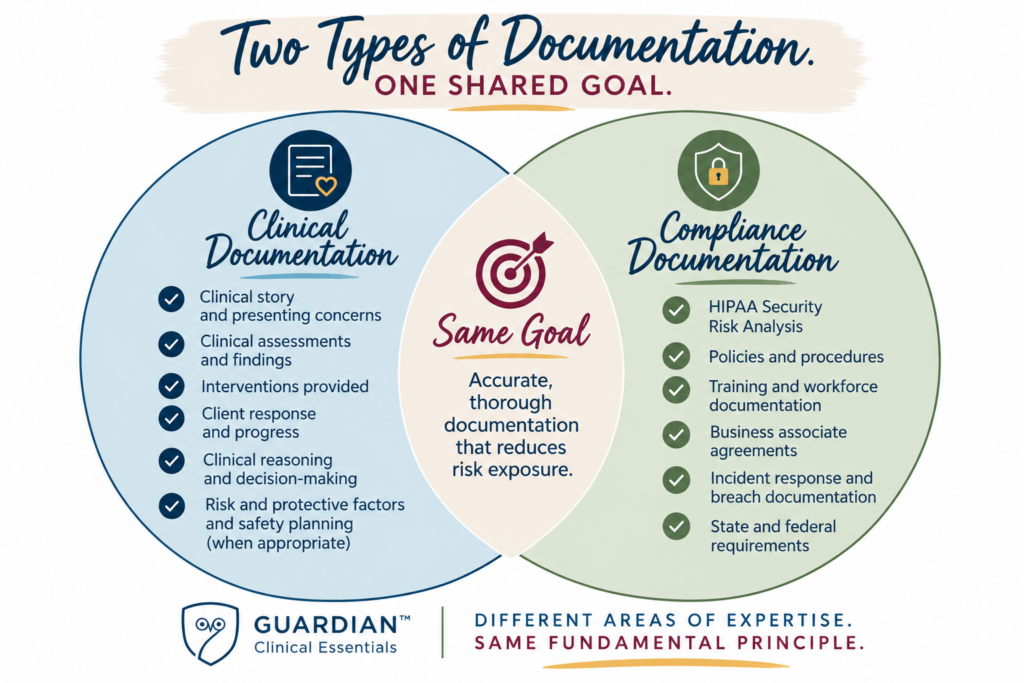
Beth and I have spent a lot of time talking about how good clinical documentation helps reduce a therapist’s risk exposure while protecting both the client and the practice. When your records accurately reflect your assessments, clinical reasoning, interventions, and decisions, you’re creating a record that supports the care you’ve provided.
But clinical documentation isn’t the only area where therapists and practice owners face significant risk exposure. That’s where my work through Guardian Clinical Essentials comes in.
Two of the biggest compliance vulnerabilities I encounter are practices that haven’t completed an accurate and thorough HIPAA Security Risk Analysis and practices that don’t have policies and procedures specific to how they operate and to the federal and state requirements that apply to them.
Under the HIPAA Security Rule, covered entities must conduct an accurate and thorough assessment of potential risks and vulnerabilities to the confidentiality, integrity, and availability of their electronic protected health information.
That requirement doesn’t disappear because you use a well-known EHR or signed a business associate agreement with your software company. Your EHR vendor’s BAA is not a magical force field protecting everything else your practice does. I really wish it were. My job would be considerably easier.
And then we have policies and procedures. Borrowing a set from your friendly neighborhood therapist two towns over might seem convenient, but unless you’re running identical practices with identical technology, workflows, safeguards, and legal requirements, there’s a good chance those documents don’t describe what you’re doing.
No two practices operate exactly alike. Your policies and procedures need to reflect how your practice actually operates, while addressing the federal and state requirements that apply to your services, setting, and circumstances.
A beautifully organized HIPAA binder isn’t particularly reassuring if the policies inside describe procedures nobody follows, technology you don’t use, or safeguards you haven’t implemented.
And here’s where Beth’s work and mine come right back together.
Through The Documentation Wizard, Beth helps therapists make sure their clinical documentation is accurate, thorough, and reflects the care they’ve truly provided. Through Guardian Clinical Essentials, I help therapists and practice owners make sure their compliance documentation is accurate, thorough, and reflects the requirements they’ve addressed and the safeguards they’ve implemented.
Different areas of expertise, but the same fundamental principle: Accurate, thorough documentation helps protect your clients, support your professional decisions, and reduce your risk exposure.
You need that paper trail, even when it’s digital.
Different Documentation. Same Goal.
Whether we’re talking about clinical records or HIPAA compliance, your documentation needs to accurately reflect what you’ve assessed, what you’ve done, and the decisions you’ve made.
Accurate, thorough documentation helps protect your clients, support your professional decisions, and reduce your risk exposure.
Who has time to track every new AI, HIPAA, and privacy law? Apparently, I do. And I love it!
Sign up for the Guardian Clinical Essentials newsletter and get important compliance updates for behavioral health practices delivered straight to your inbox. No fluff, just the developments worth knowing about.
So What Should Therapists Take Away From All This?
I didn’t come away from my conversation with Beth thinking therapists need another 17 forms added to their intake packets. Quite the opposite. I came away thinking we need to be more intentional about the documentation and decisions that truly matter.
Tell the clinical story. Ask the difficult questions when risk is involved. Document the reasoning behind important decisions. Don’t assume a safety plan is the answer to every concerning statement. Understand when HIPAA permits provider communication, and don’t let misconceptions interfere with appropriate coordination of care.
And remember that good clinical documentation is only one part of protecting a practice.
The Lindsay Clancy case is a painful reminder of how serious the consequences can be when clinical situations become complicated. We should learn from the questions it raises without pretending we know everything the treating professionals knew, or could have known, at the time.
Beth and I approached this conversation from different specialties, but we kept arriving at a similar point: therapists need to understand what they’re doing, why they’re doing it, and how to document and support those decisions appropriately.
Because if we’re going to spend all this time documenting what we do, shouldn’t it at least be the right stuff?
Guardian Clinical Essentials™ provides behavioral health practices with customized compliance documentation, HIPAA resources, and consulting services addressing privacy, security, vendor management, and emerging technology requirements.
This article is provided for educational and informational purposes and does not constitute legal advice. Practices should evaluate the laws, licensing requirements, professional standards, and technology applicable to their specific operations.
Frequently Asked Questions
About Therapy Documentation, Risk Assessments, and HIPAA
What should therapists include in their progress notes?
Therapy progress notes should document the clinical story, including relevant assessments, interventions, client responses, treatment progress, and clinical reasoning. The goal is to create an accurate record that supports the care provided, not a transcript of everything discussed during the session.
Documentation should include relevant symptoms and clinical findings, progress toward treatment goals, and the reasoning behind significant clinical decisions. When a therapist makes an important treatment or safety-related decision, the record should demonstrate what information informed that decision and why the chosen approach was appropriate. Notes should be sufficiently thorough without unnecessarily including sensitive details of the client’s personal life.
What should therapists document when assessing suicide risk?
Therapists should document relevant suicide risk findings, protective factors, clinical judgment, interventions, and the rationale for their treatment and safety decisions. The record should demonstrate how the therapist evaluated the concern and responded to the client’s circumstances.
Depending on the assessment, documentation may include suicidal thoughts, intent, planning, access to means, relevant history, protective factors, and changes in risk. Therapists should also document clinically indicated safety planning, consultations, referrals, and decisions about the appropriate level of care. The goal is to make the clinical reasoning understandable, not simply record a risk rating or note that the client denied suicidal ideation.
When is a therapist required to create a safety plan?
A therapist should create a safety plan when clinically indicated by the client’s assessed risks and needs, or when applicable laws, professional standards, or organizational requirements call for one. A safety plan is not automatically required for every therapy client.
The decision should reflect an individualized assessment of the client’s presentation, risk factors, protective factors, and current circumstances. When a safety plan is appropriate, the therapist should document the assessment, the plan developed, the client’s participation, and the clinical reasoning supporting the response. Safety planning does not replace additional interventions or a higher level of care when those are necessary.
Can therapists share client information with another provider without a release of information?
Yes. HIPAA generally allows covered healthcare providers to share protected health information with other healthcare providers for treatment purposes without a signed HIPAA authorization. However, additional federal or state confidentiality protections may restrict certain disclosures.
For example, psychotherapy notes as specifically defined by HIPAA generally require authorization for disclosure, subject to limited exceptions. Certain substance use disorder treatment records may also be subject to 42 CFR Part 2, and state laws may impose additional restrictions. Therapists should determine which requirements apply before disclosing information and document clinically significant care coordination.
Does HIPAA require therapists to limit the information they share with other treating providers?
HIPAA’s minimum necessary standard generally does not apply when healthcare providers disclose or request protected health information for treatment purposes. This means therapists are not required to apply HIPAA’s minimum necessary limitation to those treatment disclosures.
However, this exception does not override more restrictive confidentiality laws or eliminate professional responsibilities. Therapists should use appropriate clinical judgment when coordinating care, consider the client’s circumstances, and ensure disclosures serve a legitimate treatment purpose. Additional protections may apply to particular records or types of information.
How detailed should therapy progress notes be to protect against licensing complaints or malpractice claims?
Therapy progress notes should be detailed enough to demonstrate appropriate assessment, treatment, clinical reasoning, and follow-through without including unnecessary personal information. No particular amount of documentation guarantees protection against licensing complaints or malpractice claims.
A defensible clinical record helps explain what the therapist knew, what actions were taken, and why those decisions were clinically appropriate. This may include risk assessments, interventions, client responses, consultations, referrals, and relevant care coordination. Accurate clinical documentation is one part of professional risk management. Therapists must also maintain appropriate privacy and security safeguards, required HIPAA compliance documentation, and other records that demonstrate how their practices meet applicable obligations.

Meet Beth Rontal,
Documentation Wizard®
Beth Rontal, LICSW, is a psychotherapist, educator, and founder of The Documentation Wizard. She helps therapists translate their clinical knowledge and judgment into documentation that clearly communicates the care they provide.
Her signature seven-hour training, Misery or Mastery: Essential Documentation for Psychotherapists, covers clinical documentation from intake through discharge, including the clinical reasoning and medical necessity supporting treatment.
Beth also offers clinical and administrative documentation resources, including her Crisis Management Intervention Prompts, which support documentation of crisis interventions but are not intended to replace training in risk assessment or crisis intervention.
Explore Beth’s training and resources at DocumentationWizard.com.
Related Articles & Resources for Therapists
This article is part of the Guardian Clinical Essentials™ HIPAA & Practice Compliance Article Hub, created to help therapists and behavioral health practices understand how privacy, security, and compliance requirements apply to running a successful and safe therapy practice.
You may also want to read these related topics:
- HIPAA Risk Assessments for Therapists: What Mental Health Providers Are Actually Required to Do
- HIPAA Documentation Requirements for Therapists: What Documentation Does a Practice Actually Need?
- What to Do If You Think You Violated HIPAA (Step-by-Step for Therapists)
- Do You Need Client Consent to Use AI?
- What Should an AI Policy Include for a Therapy Practice?
About the Author
Samantha Schalk, LMSW-C, LMSW-M, CAADC, CIMHP, BCP3, CHPSE
Samantha is a licensed mental health professional, private and group practice owner, Certified HIPAA Privacy Security Expert (CHPSE), and the founder of Guardian Clinical Essentials™.
Her work focuses on helping therapists and behavioral health practices understand and implement requirements involving HIPAA, privacy, security, documentation, technology, and practice operations.
Drawing from her experience in clinical practice, supervision, practice ownership, and compliance consulting, Samantha develops practical compliance resources, training, and implementation guidance specifically for behavioral health professionals.
Learn more about Samantha and Guardian Clinical Essentials™.

Continue Exploring Guardian Clinical Essentials™
Looking for additional compliance, privacy, AI, documentation, and practice operations resources?
Explore the Guardian Clinical Essentials™ Resource Library for educational articles, implementation guidance, training opportunities, and practical resources designed specifically for mental health professionals.